Pragmatism plays a role in constitutional
interpretation—and stare decisis
This essay appeared in Law & Liberty on March 25, 2019 (here). Thanks to The Originalism Blog (here).
Commenting on a piece I wrote for American Greatness, my colleague Mike Rappaport agrees with me in
certain respects but chides me for being a proponent of “the old originalism,” which he regards as
“false,” “problematic,” and “not real originalism.” Rappaport [1] considers
himself a “new originalist,” which means that he would follow the original
meaning of the Constitution wherever
it takes him, even if doing so would create more opportunities for “willful”
(or non-originalist) judges to make up rights (as they often do). I accept Rappaport’s
criticism in the spirit in which was given, and concede that my piece cited the
“privileges or immunities” clause of the 14th Amendment, moribund
since the Slaughter-House Cases
(1873), as a provision that the Supreme Court should not resuscitate, as many
legal scholars now advocate, in part
because of the jurisprudential mischief it would likely inspire.
Does that make me a “faux” originalist? I confess to favor leaving a 150-year old precedent in place, despite considerable sentiment that it was wrongly decided—although critics differ greatly in their reasoning—but contend that my position is consistent with “real” originalism. My explanation follows a brief digression on the current state of originalism.

There are many flavors of “originalism”:
new, old, original intent, original public meaning, original methods, “faint-hearted,”
“living,” “constructionist,” libertarian, “rule originalism,” and more all the
time. The various theories of originalism are based on normative arguments,
popular sovereignty, super-majoritarianism, and utilitarian (consequentialist)
appeals, presumptions of liberty, and other bases outlined in Rappaport’s 2013
book Originalism and the Good
Constitution (co-authored with John McGinnis). Theorizing about constitutional
law—even the narrower field of originalism–has become a cottage industry in the legal academy, and
the subject has spawned a staggering number of books, articles, symposia, academic
centers, and blog posts. Originalists have developed their own jargon, with
arcane terms such as “construction zones,” “interpretation zones,” and “legal turns.”
I have described this din as “a veritable Tower of Babel—a constitutional cacophony–at
times.” Creative theories abound, and new “insights” are discovered with
alarming frequency. Just keeping abreast of the burgeoning scholarly literature
is a full-time job. To be candid, as a non-academic I monitor these developments—some
of which border on hair-splitting, churning, or “law office history”–from
afar. The spate of inventive theorizing in the name of originalism—increasingly
esoteric and open-ended–reminds me of the torrent of “non-interpretive”
scholarship that flowed from the law schools in the 1970s and 80s. In other
words, originalism–now in iteration 3.0 according to some observers–is the new sandbox for the legal academy: fodder
for the tenure mill.
McGinnis has observed that “sometimes there seem to be as many theories of
the [Fourteenth Amendment] as there are
theorists,” and the multiplicity of viewpoints only grows larger when focusing
on the Constitution as a whole. Self-described “originalists” can reach
completely divergent conclusions regarding the Constitution, while purporting
to follow the same methodology! Some
scholars have even defended the activist abomination of Obergefell on “originalist” grounds. As I have stated, “If the ‘new’ originalism is so malleable
that it can be pounded into the shape of any desired result, it is not a useful
guide for constitutional decision-making.”
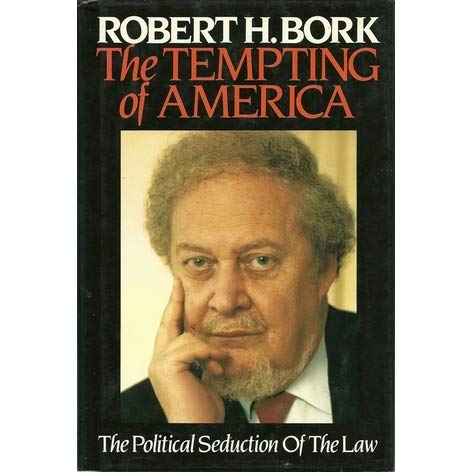
I use the term “originalism” more broadly than the specialists to mean taking the Constitution seriously as a legal text—and interpreting it accordingly. When the text is simply unclear, the judge should not guess at its meaning. If this makes me a “faint-hearted” originalist (as Justice Scalia described himself), or an “old” originalist (like Robert Bork), so be it.
In their book, Rappaport and McGinnis develop a “normatively optimal approach to precedent under originalism,” pursuant to which “there must be strong countervailing benefits to justify to following nonoriginalist precedent.” I, in contrast, take a looser, fusionist approach to stare decisis, partly formalistic, partly pragmatic, and partly originalist. The Constitution has been around for over 230 years, and during that time the ever-shifting members of the Supreme Court have issued many thousands of decisions, purporting to act as neutral arbiters of the law. Predictability and stability—as well as the Court’s institutional credibility—require that past decisions be accorded some weight. A judicial system would be chaotic and unworkable if every issue of constitutional interpretation—starting with the threshold question of judicial review–began with a clean slate. The public would justifiably question the moral authority of nine unelected judges whose edicts shifted constantly with the political composition of the Court.

Back to the Slaughter-House Cases. Many scholars
criticize the decision (or at least the majority’s reasoning), but few quarrel with the result. A group of butchers in the New Orleans area objected to an 1869
Louisiana state law regulating the operation of slaughter-houses, an activity that produces
large quantities of animal viscera, blood, waste, and carcasses, capable of
fouling drinking water and leading to disease outbreaks, such as cholera
(especially in a pre-antibiotic era).
The plaintiffs in the Slaughter-House
Cases had long conducted their operations along the banks of the
Mississippi River, upstream of the city, polluting the residents’ water
supply. Pursuant to state law, the
slaughter-house operations were moved downstream and placed under the exclusive
control of a state-chartered corporation. The affected butchers, none of whom
were African-American (let alone freed slaves), claimed that the restrictions
violated their rights under the recently-enacted 13th and 14th
Amendments.
By a 5 to 4 vote, the Court
sensibly rejected these claims. There was no “involuntary servitude,” of
course; in the pre-Lochner era, there
was no substantive due process right to engage in economic activity; and the
Court construed “equal protection” to limit only race discrimination. Unwilling to encroach upon the state’s police
power without any clear textual guidance, the Court read the “privileges or
immunities” clause narrowly to avoid becoming “a perpetual censor upon all
legislation of the states.” Limiting “privileges or immunities” to the rights
of U.S. citizenship effectively rendered the privileges or immunities clause
meaningless, but the alternative—urged by Justice Stephen Field for the four
dissenters—was to unleash indeterminate “natural and inalienable rights.”
Some scholars, such as Bork, Lino
Graglia [2], Michael Stokes Paulsen [3], and Michigan Chief Justice Stephen Markman, support the majority’s
ruling, while others quibble with the limitation of the privileges or
immunities clause to federal rights.
In Government by Judiciary (1977), Raoul
Berger disputed the majority’s reasoning, even as he concluded that the 14th
Amendment was intended only to validate the Civil Rights Act of 1866. Kurt Lash
concludes that the 39th Congress
intended to incorporate the first eight amendments of the Bill of Rights in the
privileges or immunities clause—but not to open the Pandora’s Box of “unenumerated
rights.”
There are as many scholarly positions regarding the Slaughter-House Cases [4] as there are theories about Amelia Earhart’s disappearance or who kidnapped the Lindbergh baby. Few scholars, however, aside from libertarian proponents of “judicial engagement,” embrace the radical position taken by the dissenters. Because the Bill of Rights have been incorporated under the due process clause, the historical “correctness” of the Slaughter-House Cases is effectively moot.
Accordingly, my position that the Slaughter-House Cases should be left alone is based on a combination of reasons: I agree with Bork, et al. that the majority was correct, or at least that the meaning of “privileges or immunities” is unclear enough to warrant a restrained interpretation; I strongly disagree with the notion of unenumerated rights (not because it will lead to mischief, but because it is mischief); and, at this point, the precedent is so old and well-established (even if not universally accepted) that, pursuant to stare decisis, it would undermine public confidence in the Court to overrule it. If that disqualifies me as a “new originalist,” so be it.
The original goal of
originalism, it must be remembered, was to restore constitutional law to the
task of interpreting the Constitution. As Bork famously remarked in 1982, “The
truth is that the judge who looks outside the Constitution always looks inside
himself and nowhere else.” [5] Hewing to the constitutional text necessarily
grounds—or “constrains”—judges, which is the whole point of having a written constitution. It is a fallacy to assume that “constraint” is
incompatible with originalism.
[1] Since we are
acquaintances going back to my San Diego days, I would prefer to call him Mike,
but in keeping with the conventions of this site I will refer to him as
Rappaport.
[2] E.g., Lino Graglia, “Do We Have an Unwritten Constitution?–The
Privileges or Immunities Clause of the Fourteenth Amendment,” 12 Harvard Journal of Law & Public Policy
83 (1989).
[3]
Michael Stokes Paulsen & Luke Paulsen, The Constitution: An Introduction
190-91 (2015).
[4] E.g., Philip Hamburger, “Privileges or Immunities,” 105 Northwestern University Law Review 61 (2015) (arguing that it was intended only to apply the “comity clause” rights in Art. IV to blacks).
[5]
Robert Bork, “The Struggle Over the Role of the Court,” National Review
(September 17, 1982).