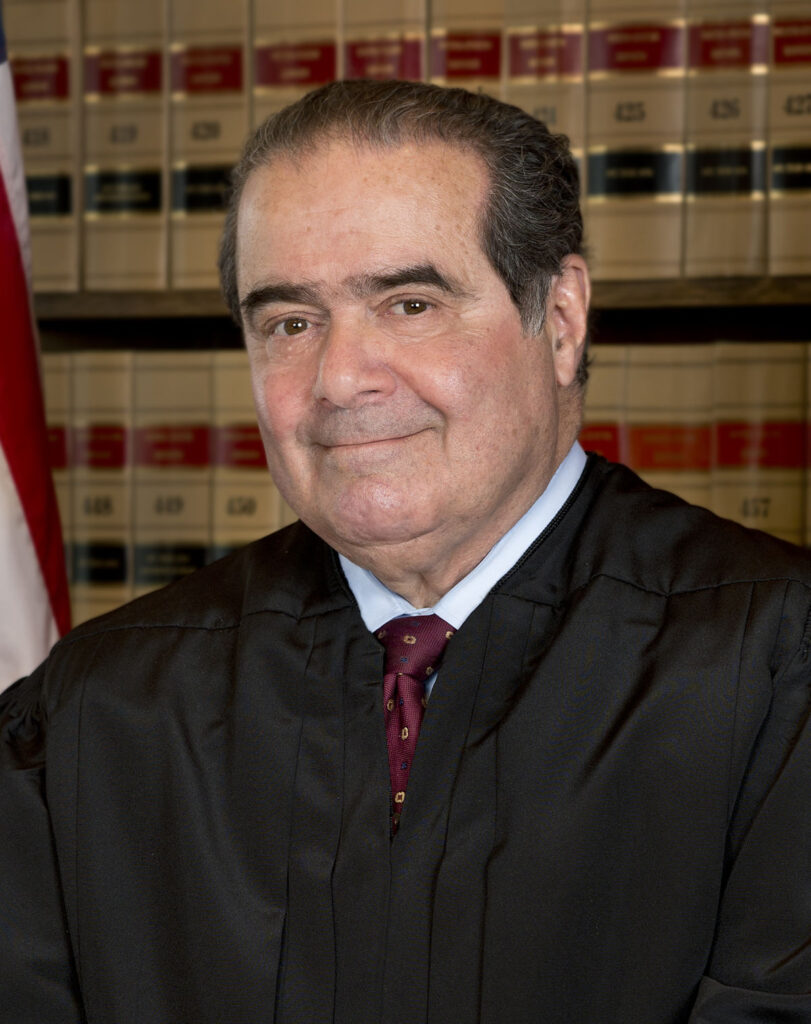
Scalia: A Colossus on the Court
The Kid from Queens did not single-handedly turn the Burger Court around, or live to see the conservative shift to fruition, but more than anyone else he put the process in motion.
This essay appeared in Law & Liberty on February 25, 2026 (here). Thanks to Power Line, Real Clear Books (here), the Tennessee Star (here), and The Originalism Blog (here)!
A decade after the untimely death of Justice Antonin Scalia in 2016, veteran journalist James Rosen has released the second volume of his magisterial biography of the great jurist, entitled Scalia: Supreme Court Years, 1986-2001. The first volume, reviewed here by former Scalia clerk Ed Whelan (in an essay entitled “How Little Nino Became Justice Scalia”), was widely acclaimed for its thoroughness, “sparkling prose,” and deep mastery of the legal intricacies that animated Scalia’s career—rare for a non-lawyer author. Whelan praised the first volume, published in 2023, observing that “Rosen’s research is exhaustive and meticulously documented across 65 pages of endnotes.” Reviewers also noted that Rosen’s treatment of his subject, while not hagiographic, was refreshingly fair-minded compared to previous “poison pen” biographies of Scalia authored by Joan Biskupic (2009) and Bruce Allen Murphy (2014).
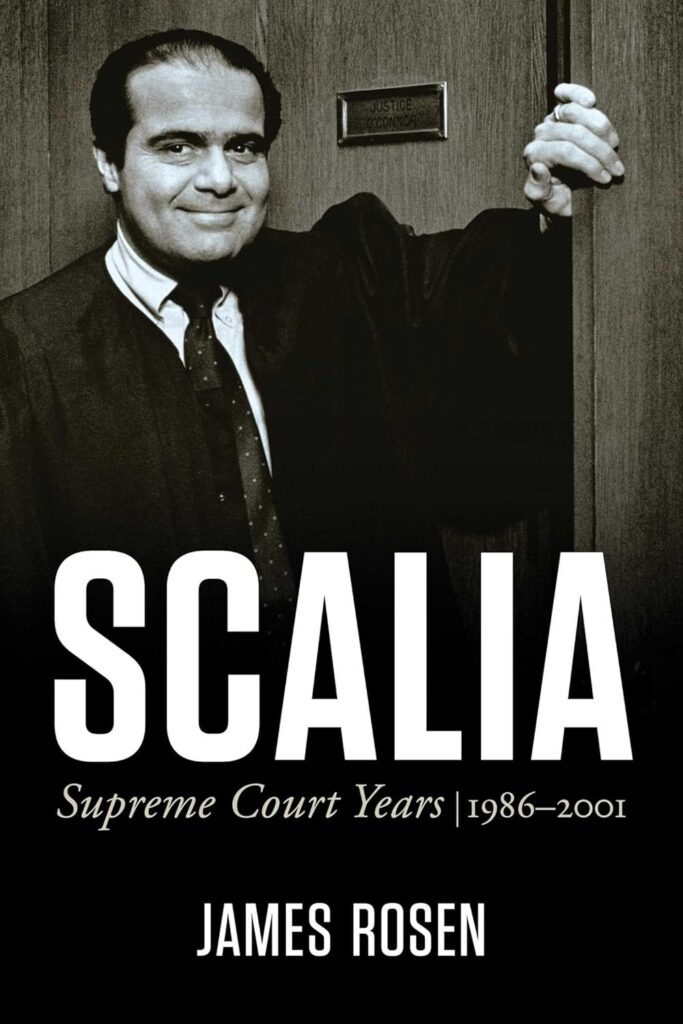
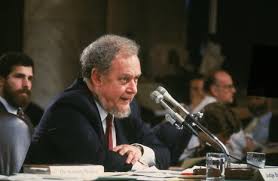
Volume one was only the appetizer. Volume two, covering Scalia’s tenure on the Supreme Court from investiture through the national drama of Bush v. Gore (2000), is the main course. And what a feast it is! (There will be a third and final volume covering the period 2001-2016—shades of Robert Caro!) Legal scholar Stephen Presser marveled that in researching the first volume, Rosen “apparently interviewed virtually everyone alive who knew Scalia well.” Rosen doubles down in volume two, with over 100 interviews, an army of sources, extensive archival research, quotes from oral arguments, review of internal Supreme Court documents, 48 pages of end notes, and many family photos. The prose remains felicitous (e.g., Robert Bork, “possessor of an exceptionally dour mien…resembled the king in a deck of playing cards”), and the narrative gripping, as Rosen chronicles Scalia’s storming of the “Marble Temple” (as the Court’s building is called) following his appointment by President Reagan in 1986. Amazingly—at least by today’s standards–the Senate confirmed Scalia by a 98-0 vote.
Rosen’s trilogy will undoubtedly be regarded as the definitive biography of Scalia. Rosen exhibits a deep understanding of Scalia in all his facets. However interesting and impressive Scalia was as a student, lawyer, government official, law professor, legal scholar, and judge on the D.C. Circuit—as volume one entertainingly portrays–his enduring fame will be due to his role on the Supreme Court. Rosen comprehensively explores Scalia’s arrival on the Court with erudition and impressive attention to detail. We tend to forget how shabby the Supreme Court’s jurisprudence (which I have termed “an incoherent mélange of liberal pablum, a doctrinal wasteland”) was upon Scalia’s investiture as an Associate Justice in 1986, succeeding William Rehnquist, whom President Reagan elevated to Chief Justice due to the retirement of Warren Burger.
The Court routinely interpreted statutes based on their unreliable legislative history, rather than their actual text. Constitutional interpretation often had no relation to the original public meaning of the provisions in question; “originalism” was an embryonic notion not yet in the mainstream. Mimicking legislators, the justices frequently used “balancing tests” to determine constitutional meaning. A bloc of justices voted to overturn death penalty cases simply because of their personal disagreement with capital punishment. Separation of powers was a hoary concept taught in political science classes, not a fixture of Supreme Court decision-making. Oral arguments were generally boring. The justices’ opinions were sometimes sloppy, haphazard, and arguably incoherent. “The Brethren”—as Bob Woodward and Scott Armstrong referred to the justices in a 1979 insider account of the 1969-1976 Burger Court—were a gaggle of contentious personalities pursuing their personal predilections, not the vanguards of an intelligible judicial philosophy.
Scalia joined a Court that—even with a majority of justices appointed by Republican presidents—had recognized a constitutional right to abortion (Roe v. Wade), approved racial preferences in higher education admissions (University of California Regents v. Bakke), declared the death penalty unconstitutional (Furman v. Georgia), and a few years later changed its mind (Gregg v. Georgia). Rehnquist, appointed by President Nixon in 1972 and for many years the only conservative on the Court, was dubbed the “Lone Ranger” for writing over 50 solitary dissents. The “living Constitution” was alive and well. The Court was ripe for disruption, and the ebullient “Kid from Queens,” profiled so well in volume one, was the perfect candidate.
Scalia was a force of nature. He approached the task with a unique combination of traits, previously unseen on the Court. He was a doctrinal purist who reveled in debate, a towering intellect with little patience for inconsistency or imprecision. He possessed a natural flair for showmanship coupled with supreme self-assurance. He was a titanic personality exuding personal charm and an undeniable charisma (as evidenced by his unanimous Senate confirmation). At age 50 the youngest member of the Court, Scalia was—in contrast to the other justices–extraordinarily energetic. His staid colleagues, not used to Scalia’s Socratic manner and appetite for spirited discourse, often leavened with humor, didn’t know what to make of him. (The liberal justices were especially dismayed.) At oral argument, he peppered advocates with incisive questions, and applied the same rigor to his interactions with fellow justices.
Overcoming initial resistance by thin-skinned colleagues sensitive to Scalia’s criticism of some prior decisions while still teaching law (such as Justice Harry Blackmun, who authored Roe v. Wade), the indominable Scalia ignored the tradition of rookie reticence and immediately began transforming the culture of the Court–as likely no one else could have done. The Court’s jurisprudence did not reverse direction overnight—occurring, rather, in an incremental fashion over the ensuing decades–but Scalia certainly began the conservative revolution that was completed following his death. Justice Samuel Alito told Rosen in an interview that Scalia, with whom he served on the Court for a decade, “started so much and it would have been good to have him around to see it to completion.” Indeed, Scalia lit the fuse that resulted in the Court’s move toward textualism, originalism, race-neutrality, bright-line rulings, and fidelity to the structure of the Constitution.
Rosen takes the reader, Term-by-Term, through Scalia’s first 15 years on the Court, addressing the various personnel changes and giving coverage to both Scalia’s opinions and his considerable extra-curricular commentary, such as speeches, law school lectures, articles, and even a book, entitled A Matter of Interpretation.
The Court’s evolution, aided by the subsequent addition of conservative stalwarts such as Justices Clarence Thomas and Samuel Alito, and complicated by ruptured relationships with other justices (such as Sandra Day O’Connor), can be gauged by some anecdotes bracketing the period covered by volume two. Early on, the antagonism faced by Scalia from certain justices (and their clerks, often chosen based on ideological compatibility) can be seen in unsealed Court records, previously unpublished, drawn from Blackmun’s archive. In the interest of efficiency, the justices do not individually review the thousands of requests for review (called “cert. petitions,” an abbreviation for “certiorari”) filed with the Court each year. Instead, most justices participate in a “cert. pool,” pursuant to which each cert. petition is assigned to a clerk for one of the participating justices, who then writes a memo analyzing the merits of the petition, which is circulated to the justices in the pool. Nearly all cert. petitions are rejected; the Court only hears a small fraction of the cases seeking review.
Blackmun (who in his waning days on the Court relied heavily on his clerks) and Scalia were among the justices who participated in the cert. pool. When one of Scalia’s clerks wrote the cert. pool memo, Blackmun’s clerks would offer snide comments to Blackmun criticizing Scalia’s clerks for their “audacity,” lack of empathy, “overzealous evilness,” etc., even when they agreed with the recommendation in the cert. pool memo. Blackmun would make marginal notes sharing his agreement with the clerks’ hateful comments, in effect egging them on. Beginning in Scalia’s second term, when one of Scalia’s clerks was Federalist Society co-founder Steven Calabresi (now and for decades a law professor at Northwestern), Blackmun’s clerks started targeting cert. pool memos written by clerks thought to be members of, or aligned with, the Federalist Society—as if that affiliation alone made the author of the cert. memo suspect.
Rosen properly views this practice–“mark of the devil!,” he facetiously calls it—as evidence of bias on Blackmun’s part, which is especially offensive when one considers that Scalia helped found the student chapter at the University of Chicago while he was teaching there. Blackmun and his liberal clerks detested what they perceived to be “Fed Soc” thinking. Rosen notes that “This practice in Blackmun’s chamber continued for years, with other Federalist Society alumni working for Scalia, and those in other chambers—Rehnquist’s, O’Connor’s, Anthony Kennedy’s—all similarly branded.” (Emphasis in original.) [Disclosure: I am a long-time member of the Federalist Society.] Blackmun’s bitterness toward Scalia persisted until Blackmun’s retirement in 1994.
What made Scalia so influential as a jurist was not just his intellect, or his uncompromising approach to judging, but also his incomparable talent for writing with utter clarity and, when necessary, a sharply-acerbic tone sometimes bordering on vitriolic. His words could cut like a knife, and in some cases left lasting wounds. (Even his close friend, Robert Bork, never forgave Scalia for a slashing dissenting opinion Scalia wrote in a libel case while they were colleagues on the D.C. Circuit, accusing the “bearded don of judicial restraint” (Rosen’s words) of judicial activism for some comments made in a concurring opinion.[*] The en banc opinion was authored by Judge Kenneth Starr, Bork’s concurring opinion was joined by three fellow conservatives, Malcolm Wilkey, Douglas Ginsburg, and George MacKinnon, and Scalia’s dissent was joined by two Carter appointees. The Supreme Court denied cert., suggesting that the en banc decision was not as misguided as the dissent claimed.)
The strong-willed Scalia would try to influence the other justices in internal memoranda commenting on draft opinions, and when that failed would unleash his scathing rhetoric in a separate opinion intended for a larger audience: posterity, the general public, and, especially, law students who were mesmerized by his forceful prose. Ever the law professor, Scalia wrote his opinions as tutorials on the correct way to interpret the Constitution and federal statutes. Justices who were unaccustomed to being called out in his inimitable fashion sometimes took offense, despite Scalia’s personal affability. It required Herculean efforts to dislodge the Court’s “living constitutionalism,” and Rosen convincingly argues that Scalia’s powerful opinions—however impolitic–played a key role.
As the anecdote recounted above involving Scalia and Bork on the D.C. Circuit illustrates, Scalia could—and did—write strident dissents whenever he disagreed with the majority (or even a concurring) opinion, whether authored by a “conservative” or a “liberal.” For example, in an abortion case that presented the possibility of overturning Roe v. Wade, Webster v. Reproductive Health Services (1989), the Court instead produced a badly-fractured decision upholding the controversial precedent. Scalia took strong exception to O’Connor’s concurring opinion in Webster, and may have soured his relationship with her (as Rosen discusses at length in chapters 11 and 12) by saying that her reasoning “cannot be taken seriously.”
The unswerving Scalia also wrote a strong solo dissent in Morrison v. Olson (1988), involving the constitutionality of the independent counsel provisions of the post-Watergate Ethics in Government Act of 1978. The majority opinion was written by Chief Justice Rehnquist. Undeterred, Scalia wrote what he considered to be the most powerful dissent of his career, containing the famous phrase “this wolf comes as a wolf”–arguing that independent counsels violate the separation of powers. Although he did not convince his colleagues to void the law, Congress eventually allowed the statute to lapse in June 1999. Scalia’s dissent is now widely-regarded as prescient.
As Rosen explains, Scalia was not a doctrinaire conservative. He viewed himself as an unsparing originalist and textualist. Scalia’s devoted wife, Maureen, confirms that “The worst thing you could say in the Scalia house was ‘results-oriented.’” Accordingly, Scalia’s jurisprudence was both unbending and occasionally unpredictable. Sometimes, as in Texas v. Johnson (1989), he joined the Court’s liberals, providing the deciding vote in a 5-to-4 decision (with Rehnquist dissenting) to hold that burning the American Flag is protected speech under the First Amendment. In R.A.V. v. City of St. Paul (1992), he wrote the majority decision striking down an ordinance banning offensive symbols as overbroad, even though it resulted in the reversal of convictions for a racially-motivated cross-burning. The Court’s holding was unanimous. A diehard defender of corporate defendants would have joined the majority opinion in BMW v. Gore (1996), placing due process limits on the recovery of excessive punitive damages in civil cases. Instead, Scalia dissented.
In similar counter-intuitive fashion, Scalia adopted a pro-criminal defendant view of the Fourth and Sixth Amendments, dealing with warrantless searches and the Confrontation Clause, respectively, not hesitating to exclude evidence or reverse convictions on grounds that some conservatives consider “technicalities.” He did not soften his views over time, as some justices do; one of his early opinions, in Coy v. Iowa (1988), reversed the conviction of a defendant who sexually-assaulted two 13-year-old girls. Scalia was fond of pointing to such liberal results as proof that he was doing his job in a principled way. An honest judge, following the law, will not always agree with the results. Conversely, if a judge always arrives at a congenial result, he is probably doing something wrong.
Scalia’s devotion to bright lines occasionally resulted in unpopular decisions, such as the holding in Employment Division v. Smith (1990), a religious freedom case that led Congress to enact—by a nearly unanimous vote—the Religious Freedom Restoration Act of 1993. On some issues, especially “cultural” ones such as abortion, homosexual rights, and same-sex marriage, Scalia was an unflinching opponent of the recognition of constitutional rights not grounded in the original public meaning of the Constitution.
Volume two concludes with an extraordinarily-detailed analysis of the Court’s controversial (and highly-disputed) decision in Bush v. Gore (2000), devoting two chapters to the case which put an end to the legal wrangling in Florida over a re-count of votes to resolve the bizarrely-close 2000 presidential election. Florida excepted, the hard-fought 2000 election resulted in an Electoral College tie. In the pivotal Sunshine State—with its 25 electoral votes–candidate George W. Bush appeared to have won, beating Al Gore by a razor-thin margin. On election night, Gore had even conceded. But then Gore changed his mind, and Gore’s legal team, with the assistance of the left-leaning Florida Supreme Court and local Democratic functionaries, pressed for a manual county-by-county re-count without any consistent standard for determining how to resolve disputed ballots. For four weeks, the election was up in the air, as an army of lawyers swarmed the state generating a maelstrom of litigation.
The U.S. Supreme Court, which normally spends months deciding cases, was forced into the fray on a highly-expedited basis, reviewing briefs, entertaining oral arguments, and deliberating in a whirlwind fashion, resulting in a heroic, unanimous, per curiam (unsigned, but penned primarily by Rehnquist) remand to the Florida Supreme Court issued on December 4, 2000. The Court was sending an unmistakable message to the Florida Supreme Court: We are going to give you a final chance to get this right before we jump in with both feet. As Rosen explains:
The justices demanded their colleagues in Florida explain whether they believed the state’s constitution could be cited to limit the state legislature’s authority to appoint electors under Article II; and how Title 3 [of the U.S. Code, regulating the resolution of election disputes in 3 U.S.C. section 5, with a hard deadline of December 12 for the certification of the state’s electors] factored into their November 21 decision.
Instead of taking the hint, the “Florida justices…thumbed their nose at the Marble Temple.” Just when things seemed to be settled, with Bush’s narrow lead—a mere 537 votes, as confirmed and certified by the Florida Secretary of State–providing the margin of victory, on December 8 a sharply-divided Florida Supreme Court plunged the country further into confusion by a wholesale re-writing of the Florida election laws and an order to selectively hand count certain ballots, with no uniform standard on whether “dimpled chads” should be counted as votes. The Florida justices had simply ignored the remand order. “Scalia was livid,” Rosen reports. Fortunately, the U.S. Supreme Court ended the crisis when it stayed the recount on the next day, and issued its ruling in Bush v. Gore (also per curiam, but mainly midwifed by Rehnquist and Kennedy) on December 12, reversing the Florida Supreme Court on equal protection grounds. Bush’s electoral victory was—finally–official, five weeks after the polls closed.
This decision, made in a very tight time timeframe, and with enormous national—even global—significance, was very contentious, both within and outside the Court. Bush v. Gore was decided by a 7-2 vote, but the Court split 5-4 on the remedy. Unaccountably, many liberal partisans blamed Scalia for the result, although the Court’s internal documents clearly show otherwise. Rosen concludes that “Contrary to the mythology, the Court records unsealed to date have not revealed a major role for Scalia in the outcome of Bush v. Gore.” In the mind of the legal academy and commentariat, however, Scalia now so clearly dominated the Court that he served as the lightning rod for their criticism. Such is the price for becoming a Colossus.
Volume two is a judicial biography, and not a constitutional law treatise, but even lawyers will be impressed at the degree of sophistication and nuanced understanding of the legal issues that Rosen displays. Rosen does not endeavor to discuss all of the cases in which Scalia participated during the period 1986-2001, but he selects the most interesting cases and provides keen insight into the oral arguments, the Court’s conference deliberations, jockeying over draft opinions, and the ripple effects in terms of public and media reaction, future cases, and, occasionally, legislative action. Moreover, it is full of insider anecdotes, colorful vignettes, and behind-the-scenes drama (and humor) that readers will not find in the United States Reports, where the Court’s decisions are published.
In the genre of books about the Court, or biographies of justices, it is a lively romp, and a joy to read. The anecdote about Supreme Court advocate Carter Phillips car-pooling with Scalia and Kennedy in snow-blocked roads during the Blizzard of ’96 to appear for an oral argument the Chief Justice refused to postpone is hilarious. Light-hearted fare such as the saga of Scalia’s short-lived experiment with a beard (which his wife hated), and Scalia’s love of the modest Italian restaurant A.V. Ristorante, enlivens the legal analysis. One of Rosen’s most effective literary devices, as narrator, is to emphasize certain words by repeating them, with ellipses and italics, as Tom Wolfe sometimes did in his New Journalism. Rosen’s prose is on par with Wolfe’s.
Fans of Scalia will enjoy learning more about the man and the justice. Readers unacquainted with the Kid from Queens will find out why he had (and still has) so many admirers. I highly recommend volume 2 and look forward to the third and final volume.
[*] In The Tempting of America (1990), Bork devoted several pages to defending his position in Ollman v. Evans, without mentioning Scalia by name. Pp. 167-70.