None Dare Call It Judicial Activism: SB1958/HB1971 Would Restore the Judiciary to its Proper Role
Low-level trial courts should not be issuing “advisory opinions” in “facial” challenges to state laws brought by parties lacking actual standing; doing so turns Chancery Courts into mini-legislatures issuing piecemeal protests against duly-enacted statutes, at the behest of political losers and at the expense of the general public.
Thanks to the Tennessee Star (here) and Aaron Gulbransen (here)!
Introduction
In 2018, the Tennessee legislature inadvertently—and, in hindsight, erroneously—opened a Pandora’s Box by creating an avenue for radical left-wing groups such as the Center for Reproductive Rights, Democracy Forward, the National Immigration Law Center, Protect Democracy, the ACLU, and even the vile Southern Poverty Law Center to undermine the Republican-controlled General Assembly, and the actions of Republican Gov. Bill Lee, by filing unripe lawsuits before forum-shopped left-leaning trial courts. Judicial activism was unleashed.
Special interests promoting abortion rights and open borders have used T.C.A. 1-3-121 as a political weapon to circumvent the will of Tennessee’s conservative majority. Eight years later, a Republican Senator has introduced a critically-important bill to stop this unconscionable abuse of our legal system. Ironically, the most outspoken opposition to the bill is coming from an unexpected source: so-called “conservative” groups. Go figure.
I have previously spoken in support of the bill sponsored by Sen. John Stevens, SB1958, on the Michael Patrick Leahy radio show and podcast. I am prompted to expand my remarks in light of the unanimous resolution adopted by the Williamson County Republican Party on March 2 “strongly opposing” SB1958. Because I consider this resolution to be ill-advised and seriously misguided, I have drafted this article explaining my position in greater detail.
Fringe critics are discrediting themselves with shrill (and frivolous) opposition to SB1958/ HB1971, which they absurdly claim is “the most alarming bill we’ll see in 2026” (Tennessee Stands), a threat to the rule of law (Tennessee Firearms Association), and an “unconstitutional infringement upon the right of Tennesseans to seek judicial review” (Williamson County GOP). All of this is balderdash—uninformed claptrap. These groups, and others opposed to SB1958/HB1971, should be ashamed.
These groups are simply trolling for donations from their fringe base. I previously commented on the tactics of these groups, terming it “self-serving rabble-rousing calculated to sow division and discord, and to generate attention and noise. This is the antithesis of statesmanship. It is the modus operandi of a demagogue.”
By repealing T.C.A. 1-3-121 (which was enacted as SB1870 in 2018, less than a decade ago), SB1958/HB1971 would dispense with the time-wasting exercise of entertaining hypothetical, piecemeal “facial” challenges to fragments of laws some disgruntled litigant found to be displeasing, before a court that does not have statewide jurisdiction and that cannot issue an authoritative ruling.
SB1958 does not take away a “vital right”; it ends a silly and ill-conceived (and short-lived) experiment in allowing low-level trial courts (called “Chancery Courts”) to give advisory opinions that call into question the legitimacy of duly-enacted laws without awarding damages. If SB1958/HB1971 were passed, Tennesseans would retain the right to challenge any state law that was actually applied to them in a manner that caused actual injury. That is the correct method for challenging a law in court.
What is the problem?
The origins of SB1870, which was codified as 1-3-121, are murky. It received little attention and apparently attracted no controversy when it was enacted in 2018. It was signed into law by Gov. Bill Haslam. Perhaps SB1870 was a fluke—a legislative “solution” in search of a problem. Noted attorney Daniel Horwitz confirms that SB1870 was both a stealth bill (“a little-noticed law”) and unnecessary (because the Tennessee Supreme Court had already ruled—in 2008—that the doctrine of sovereign immunity does not preclude lawsuits against the state for declaratory and injunctive relief regarding constitutional violations).
In any event, SB1870 conferred authority on the least appropriate category of judges to pass judgment on all laws passed by the General Assembly, and other governmental actions. Chancery Courts are the lowest level trial court in Tennessee. [*] Under 1-3-121, a single Chancery Court judge was empowered to overrule the entire legislative branch! Tennessee is divided into 32 judicial districts, each of which has a Chancery Court. Chancery Court judges are elected, and their politics will vary depending on the electorate of the particular district. Some Chancery Court judges are very liberal, such as those in Democrat-controlled Davidson County (which has four Chancery Court judges), and were eager to second-guess the General Assembly when special interests filed lawsuits under 1-3-121.
SB1870 may have slipped through the General Assembly unnoticed, but liberal activists soon realized the gift they had received from the legislature, and the lawsuits promptly began. Enactment of 1-3-121 was like ringing the dinner bell for left-wing special interest groups seeking to thwart GOP legislation and policies.
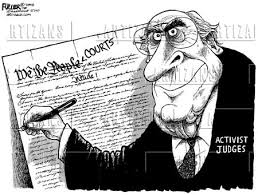
Abuses of 1-3-121 quickly became apparent, as litigants challenged Tennessee statutes in liberal Davidson County (a practice known as “forum-shopping”), where the elected Chancery Court judges would invalidate laws passed by the General Assembly for ideological reasons, such as declaring the state’s pilot school voucher program unconstitutional. (The Tennessee Supreme Court eventually upheld the law in 2022.) In 2020, a Chancery Court judge in Davidson County ruled that Tennessee must allow all eligible voters to vote by absentee ballot due to the COVID-19 pandemic! This is the type of left-wing judicial activism that is–sadly–routine from Biden- and Obama-appointed federal judges, but not in Tennessee!
An interim fix didn’t solve the problem
To curb these abuses, the General Assembly passed a law in 2021 creating “Special Chancery Courts,” consisting of three-judges, drawn from each of the state’s “grand divisions,” to reduce the influence of liberal judges and to discourage forum-shopping. T.C.A. 20-18-101. The creation of three-judge panels in lieu of single-judge rulings under 1-3-121 only increased the judicial resources required to resolve hypothetical “facial” challenges, the defense of which places a burden of the Tennessee Attorney General, who is responsible for defending the state against the lawsuits seeking advisory rulings.
The Tennessee Courts website lists 34 cases filed under 1-3-121 that have been assigned to three-judge panels. Of those, more than three-quarters (27) were filed in Davidson County! The forum-shopping continued unabated. Leftist activists know where to find the “friendly” judges, so the preferred venue is Nashville, where the Chancery Court judges are reliably liberal Democrats.
To remedy the abuse of 1-3-121, discussed below, the solution is to repeal the law. This is what SB1958 does.
The nature and importance of legislation
Laws are the rules by which a free people consent to be governed. In that sense, the legislative process represents the essence of self-government. In a representative democracy, we hold elections to choose who will serve on our behalf in the legislative branch, which is responsible for passing laws. These laws—called statutes—embody the policy decisions of the state’s General Assembly, which serves as the voice (and expression) of the people. “We the people” elect legislators to enact laws. In the legislature, as with elections themselves, the majority rules. No law is going to please all people and all groups. There are invariably winners and losers. Yet the rule of law requires that laws, once adopted, be applied evenly to all.
Every bill (with extremely rare exceptions) will be popular with some factions of the public and unpopular with others. The same with special interest groups. As a bill goes through the legislative process, complete with committee hearings, the public has the opportunity to provide input along the way. As a result of support and opposition to the bill by various interest groups, in many cases compromises will be made to the original language drafted by the bill’s sponsor. The same process occurs in both the Senate and the House. Sometimes compromises have to be made in order to gain majority support. In politics, compromise is a necessity, not a dirty word.
At the end of the process, however, the final version of the bill voted into law by a majority of the General Assembly, and signed by the Governor, will inevitably be objectionable to some element of the public. Because the majority rules, even those who disagree must accept the outcome. This is the ineluctable nature of democracy.
Statutes consist of words—sometimes lots of them. On occasion the words used in a statute, taken out of context, can appear to be vague, ambiguous, or confusing. Statutes have to be read in their entirety to understand the context. And to fully appreciate the meaning—or effect–of a particular law, it has to be applied or enforced against an actual person in the context of a concrete factual situation. Parsing disembodied words, phrases, and even entire sentences in a statute on a “facial” basis (i.e., based solely on the text of a statute, before it has been applied to an actual person in a concrete factual situation), resting on hypotheticals and speculation, is extremely problematic.
This is why “facial” challenges to statutes are disfavored; courts are more prone to error if they try to judge the wording of a statute without regard to any factual context. “As applied” challenges are those made by a person against whom the law has been enforced (or threatened with enforcement), creating a factual record that tethers the judge to reality. Most legal issues cannot be adjudicated in the abstract. This is certainly true for determining the constitutionality of a statute.
In many cases the statute must be applied to evaluate whether the statute is valid. Opponents of a statute may exaggerate (or even invent) legal objections in the hope of getting a sympathetic judge to overrule the law, thereby defeating the legislative process (and even the purpose of elections for the General Assembly—or democracy itself).
The main problem with 1-3-121 is that it allows the losing side in legislative (or political) contests to circumvent the results of majority rule by obtaining a facial ruling from a judge who shares the policy view of the opponent, without regard to the views of the majority.
It is unseemly—and undemocratic–to allow the losing side to get a second bite at the apple by filing a lawsuit under 1-3-121.
The proper judicial role
Courts play an important but limited role in our system of government. They are not arbiters of the wisdom of policies enacted by the legislature or implemented by the executive branch. Judges are not legislators. In a constitutional challenge, courts are supposed to determine if a law, as applied to a person with standing to challenge it, actually violates a provision of the Constitution—not hypothetically whether it could be applied in an unconstitutional manner.
Judges should exercise deference to the other branches because legislators and the Governor take the same oath of office that judges do, pledging to uphold the U.S. Constitution and the Tennessee Constitution. Absent a clear showing of an actual constitutional violation—based on facts, not speculation—judges are not authorized to second-guess the actions of the other branches.
The four-member, all-Democrat Chancery Court in Davidson County should not have veto power over the legislative and executive branches.
Examples of abuse
The Left often uses 1-3-121 to get left-wing judges to second-guess laws passed by the Republican controlled legislature, or actions taken by Republican elected officials. The Left’s favorite venue for bringing actions under 1-3-121 is liberal Davidson County. Here are some especially egregious examples:
Abortion rights case: Allyson Phillips, et al. v. State of Tennessee, et al. (Davidson County). Suit filed by the Center for Reproductive Rights, a radical pro-abortion group, to gut Tennessee’s law restricting abortion except for medical emergencies. Panel includes Davidson County Chancellor Patricia Head Moskal, a Democrat.
Challenging Gov. Bill Lee’s deployment of the Tennessee National Guard to restore public safety in Memphis: Mayor Lee Harris, et al. v. Gov. Bill Lee, et al. (Davidson County) Suit filed by Shelby County Mayor Lee Harris and other Democrat elected officials in Davidson County Chancery Court, with the assistance of radical leftist groups such as Democracy Forward and the National Immigration Law Center. According to the Associated Press, “A Tennessee judge…blocked the use of the National Guard in Memphis under a crime-fighting operation by President Donald Trump….[The] decision sides with Democratic state and local officials who sued, contending that Republican Gov. Bill Lee cannot deploy the Tennessee National Guard for civil unrest unless there is rebellion or invasion, and even then, it would require action by state lawmakers.” The injunction was granted by Davidson County Chancellor Patricia Head Moskal, a Democrat. (Notice a pattern?) Judge Moskal’s injunction was stayed pending appeal, which was heard on March 5, 2026. (Liberal media outlets such as Tennessee Lookout have covered this story with obvious bias in favor of the plaintiffs.)
Challenging rules maintaining order in the legislative chamber: Allison Polidor, et al. v. Cameron Sexton, et al. (Davidson County) Suit filed by the ACLU to challenge the Rules of Order of the Tennessee House of Representatives banning the display of signs in the gallery. A temporary restraining order was granted by Davidson County Chancellor Anne C. Martin, a Democrat. (Martin is the same judge who invalidated Tennessee’s school choice pilot program in 2020.)
Challenging Tennessee’s school choice legislation: Apryle Young, et al. v. Bill Lee et al. (Davidson County) Suit filed by the ACLU, the Southern Poverty Law Center, and other radical left-wing groups to invalidate the state’s universal voucher (school choice) program. The suit was filed on November 20, 2025, and has been assigned to Davidson County Chancellor Anne C. Martin, a Democrat. The case is being enthusiastically reported by Tennessee Lookout.
The case for SB1958
SB1870 was, in hindsight, a bad idea. Now, Sen. John Stevens is proposing to rescind 1-3-121 and restore Tennessee to the status quo that existed prior to its flukish enactment in 2018. This represents sound policy. Courts should not be issuing advisory opinions to litigants lacking a concrete injury (sometimes called “standing”). Without an actual “case or controversy” to decide, the Chancery Court is invited to make hypothetical rulings without a factual record. “Facial” challenges are ripe with the potential for collusion between special interests and activist judges. And it unnecessarily consumes the resources of three judges and the Attorney General’s office, which can become embroiled in extended “discovery” (i.e., fishing expeditions by left-leaning lawyers) costing the taxpayers millions of dollars.
Citizens’ rights are protected so long as they can seek judicial review if and when a law is actually applied to them. This is unaffected by SB1958.
Recall your basic civics: Sovereign citizens and constitutional conservatives need to appreciate that in a representative democracy, the legislature is the voice of the people through which laws are passed reflecting the “consent of the governed.” Advisory opinions by low-level trial courts based on a limited record, based on “facial” grounds, with no opportunity for public participation or input, are a distraction and a waste of time. They are also an engine of activist mischief. Judges—especially Chancery Court judges—are not suited for policymaking. That is the role of the legislature. Separation of powers lies at the heart of the Framers’ design.
All the hyperbole against SB1958—“strips away” rights; “places the legislature above judicial review”; etc.—is a smokescreen used by fringe groups to falsely alarm the citizenry about an imagined “crisis” that can only be averted by donating more money to the grifters’ organizations. It is performative outrage for self-serving purposes.
The same charlatans oppose fluoride in the drinking water and advocate nutty theories such as “nullification.” (Ironically, nullification proponents such as attorney Jeff Cobble sneer at the legitimacy of U.S. Supreme Court precedents and even question the validity of judicial review, but his followers turn around and compare advisory opinions by low-level trial judge judges with Marbury v. Madison (1803), which “has long been understood as part of the constitutional framework.” (Tennessee Firearms Association) This is utter hypocrisy.

Response to opposition arguments
The March 2 resolution of the Williamson County Republican Party risibly insinuates that federal law (specifically the Declaratory Judgment Act, 28 U.S.C. section 2201) allows the same type of “pre-enforcement challenges” currently authorized by 1-3-121. This is blatantly incorrect. Article III of the U.S. Constitution limits the judicial power to deciding actual “cases and controversies.” In a federal lawsuit for declaratory relief, the “controversy” must necessarily be “of a justiciable nature, thus excluding an advisory decree upon a hypothetical state of facts.” Ashwander v. Tennessee Valley Authority, 297 U.S. 288, 325 (1936)” (Emphasis added.) The U.S. Department of Justice Manual explains that “the Declaratory Judgment Act…is not an independent source of federal jurisdiction.”
In addition, the plaintiff bringing the lawsuit must have “standing,” i.e., an actual or threatened injury traceable to the challenged conduct. The DOJ Manual summarizes the relevant law: The requirement of standing prevents “a plaintiff from adjudicating abstract questions of wide public significance which amount to generalized grievances pervasively shared and most appropriately addressed in the representative branches. See Valley Forge, 454 U.S. at 474-75, quoting Warth v. Seldin, 422 U.S. 490, 499-500 (1975). Speculative claims that a proposed governmental action may result in injury to a plaintiff are insufficient to confer standing. See O’Shea v. Littleton, 414 U.S. 488, 497 (1974). The required injury must be both real and immediate, not conjectural or hypothetical. See Golden v. Zwickler, 394 U.S. 103, 109-10 (1969).” (Emphasis added.)
Thus, a federal declaratory relief action requires an actual controversy, not just “hypothetical” issues. Without a substantial actual dispute, and standing, the federal court will dismiss the action. SB1958 would simply align Tennessee law with applicable federal law.
Summary
Democratic self-government is best suited to the people’s duly-elected representatives in the General Assembly, not by a cadre of left-wing judges in Democratic enclaves such as Davidson County. Since the enactment of SB1870 in 2018, 1-3-121 has served as the go-to mechanism for Democrats and left-wing groups to stymie and circumvent Tennessee’s Republican-controlled legislature. Davidson County has become the playground for dark-money-funded radical groups and the ACLU to file lawsuits to invalidate state laws—just as left-wing groups run to Biden-appointed rogue judges to block President Trump’s agenda. To true conservatives, this state of affairs should be an abomination. Yet, when Sen. John Stevens proposed a solution, in the form of SB1958, he has faced denunciation and opposition from so-called “conservative” groups more interested in fundraising off manufactured hysteria than restoring sound state government.
Davidson County is not a separate fiefdom; it is one of 95 counties in the state of Tennessee. Its Chancery Court should not be allowed the veto legislation by issuing advisory opinions and granting injunctive relief. I strongly support SB1958 and implore the General Assembly to rescind 1-3-121, which has turned out to be a mistake. The legislature can and should correct such mistakes. The notion that repealing a law passed a mere eight years ago is an affront to the rule of law (as opponents claim) is simply ridiculous.
Footnotes
[*] According to the Tennessee Courts website, “Chancery Courts are courts of equity that are based on the English system in which the chancellor acted as the ‘King’s conscience.’ A chancellor, the judge who presides over chancery courts, may modify the application of strict legal rules and adapt relief to the circumstances of individual cases. Chancery Courts handle a variety of issues including lawsuits, contract disputes, application for injunctions and name changes.” This is not the type of court that should be determining constitutional challenges!