The deeply-entrenched mythology surrounding Clarence Darrow, patron saint of left-wing lawyers, is finally unraveling. Historians have exposed his record of jury-tampering and suborning perjury, while also debunking many fabricated aspects of his storied biography. Will these revelations reverse decades of worshipful hagiography?
Author’s note: The Clarence Darrow canon—books about the man and his lengthy career—is surprisingly extensive, and continues to grow. I was drawn to the subject as a young man by reading Irving Stone’s Clarence Darrow for the Defense. Later, as a labor lawyer, true crime aficionado, and Tennessean, I selectively read books about Darrow’s labor union cases, the Loeb and Leopold trial, and the Scopes case tried in Dayton, Tennessee. I do not hold myself out as an “expert” on Darrow, nor have I endeavored to explore the entirety of the massive—and ongoing–literature that he has spawned. My goal is to demonstrate to the casual reader that Darrow does not warrant the iconic status he has been accorded—especially as a lawyer.
Introduction
Clarence Darrow was a well-known American lawyer who was professionally active for a period of over 50 years, from 1879 until he retired after his final case in 1932. Early in his career, he was known primarily for representing labor unions and their leaders, including the radical Eugene V. Debs, one of the founding members of the Industrial Workers of the World and a five-time candidate of the Socialist Party of America for President of the United States. Later, in the 20th century, Darrow specialized in high-profile criminal cases, on the defense side. Sometimes the two practice areas overlapped, as when Darrow represented labor union figures (the McNamara brothers) accused of bombing the Los Angeles Times building (killing 21) in a sensational trial in 1911, and an earlier murder trial in 1907 representing William “Big Bill” Haywood and other labor leaders accused of assassinating former Idaho governor Frank Steunenberg. The latter case was the subject of an acclaimed 1997 book by Pulitzer Prize-winning author J. Anthony Lukas, Big Trouble.
Born in 1857 in rural Ohio, Darrow was drawn to the law because, by his own admission, “I was never fond of manual labor,” which ruled out farming and factory work as options. [1] With only one year of college, he taught school for several years, while also studying law on his own. [2] Darrow recalls that he is unsure what made him pursue the law: “I knew that I never intended to work with my hands, and no doubt I was attracted by the show of the legal profession.” [3] With the benefit of one year of study at the University of Michigan law department, and a year working in a law office in Youngstown, Ohio, Darrow passed his bar examination and in 1879 was admitted to practice in Ohio at age 22. [4]
After eight years of small-town law practice in Andover and Ashtabula, Ohio, Darrow moved to Chicago in 1888, entering the political, financial, cultural, and industrial epicenter of the Midwest. It was in Chicago that Darrow became famous—even infamous.
Darrow tried many cases, some quite significant, but is most associated in the public mind with two of his most famous cases: pleading for the lives of wealthy Chicago teen-aged thrill killers Richard Loeb and Nathan Leopold in 1924 and representing John Scopes in the widely-publicized “Scopes Monkey Trial” in 1925. He counseled Loeb and Leopold to plead guilty, waived a jury trial, and devoted his advocacy to urging the trial judge not to sentence his youthful clients to death. In this, Darrow succeeded. In the Scopes case, an ill-conceived publicity stunt staged by Dayton’s business community, the jury deliberated nine minutes before finding his client guilt of a misdemeanor. Scopes was fined $100, the Tennessee Supreme Court reversed on a technicality, and Scopes was not re-tried. Yet the case is often portrayed as the “trial of the century”!
The Origins of Darrow’s Mythology
Clarence Darrow had impressive oratorical abilities, to be sure. He could talk for hours, in colorful—even overwrought—rhetoric. Like all effective jury trial lawyers, he could “connect” with his target audience—the twelve people chosen to serve as jurors. But flowery oratory and an unctuous demeanor are common in many occupations: thespians, preachers, politicians, even salesmen, carnival hucksters, and con artists. What was it about Darrow that led journalists, biographers, and historians to deify him as “the greatest trial lawyer in American history”?
In my opinion, Darrow possessed a certain charisma, and exhorted juries with undeniable passion, but he was sacralized due to his left-wing clientele and progressive opinions, which were avant-garde during the period he was practicing law. As I have said,
Darrow in particular was lionized by writers and intellectuals because of his leftist politics and reputation for defending the downtrodden. In a career that largely overlapped with the Progressive Era, he was an outspoken opponent of organized religion (he called himself an agnostic but was really an atheist) who opposed capital punishment, represented militant labor leaders (including the radical Eugene V. Debs, president of the American Railway Union) sometimes accused of murder and violence, rejected the concept of free will, believed that criminals are not responsible for their actions, embraced socialism, and was a leading member of the American Civil Liberties Union’s National Committee.
Darrow personified the emerging post-Modern intellectual movement that ultimately defined the American Left. He was a vanguard of the liberal zeitgeist.
Geoffrey Cowan, author of the revelatory 1993 book The People v. Clarence Darrow, has said that “By the time of [Darrow’s] death in 1938, the myth had begun to eclipse the reality.” Thus, for many decades following his death in 1938, Darrow was depicted—and remembered—as an icon: “the most famous lawyer of his day,” “champion of the underdog,” “unsurpassed courtroom oratory,” “America’s greatest lawyer,” and similar encomia. Darrow contributed to the mythology with a vainglorious autobiography in 1932, entitled The Story of My Life. In it, he dramatically recounted the carefully-crafted Darrow mythology, including his transition from corporate attorney to crusader for the working man. In his telling, Darrow’s transformation was comparable to Saul of Tarsus’s conversion on the road to Damascus. The problem is, the story was totally fabricated, as were many other anecdotes he spun.
Even those sympathetic to Darrow concede that he “repeats some legends in his life story, acknowledging that autobiographies are not history.” [5] (Significantly, in the original edition of The Story of My Life Darrow had nothing to say about his notorious representation of four vigilante killers in the 1932 Massie case—the equivalent of the lynch mob that murdered Emmett Till in 1955. In later editions, he tacked on a sanitized, self-serving account that does not square with the facts.) [6]
Irving Stone’s hagiographic biography of Darrow, Clarence Darrow for the Defense, published in 1941 shortly after his death, was written with the assistance of Darrow’s ever-loyal widow, Ruby, who influenced Stone’s narrative. Later biographers regard Stone’s book, which “reinforced Darrow’s iconic status,” as “loom[ing] above all subsequent titles” (of which there would be many). [7] Stone’s hagiography, which the NYT erroneously believed “is probably the last book that will be written about Clarence Darrow,” beatified the man as one of the greatest courtroom lawyers of all time. Noted criminal defense lawyer Roy Black, a self-described “Darrow addict,” describes Stone’s Clarence Darrow for the Defense as “a fictional biography of Darrow as accurate as a made-for-TV movie.”
Even friendly reviewers acknowledged at the time that “The biography has its flaws. It is not as critical as Darrow himself might have liked it to be. It doesn’t explain all his contradictions. It doesn’t evaluate the fact that this kindest of men was capable of cruelty in his relationships with women. It doesn’t face up to the amiable weaknesses and poses that came out of a certain vanity in his make-up. It tells us that he loved to shock people, but doesn’t go into the psychological reasons.” Yet many readers who dug no deeper would conclude, based on his autobiography and Stone’s fawning Clarence Darrow for the Defense, that Darrow was a wise, noble, compassionate, and righteous advocate for the downtrodden—an inspiration for future generations of lawyers.
This image was further cemented by the hit 1955 play, Inherit the Wind, which was a highly-fictionalized representation of the so-called “Scopes Monkey Trial” in 1925, in which Darrow was pitted against William Jennings Bryan in a Dayton, Tennessee courtroom. The Scopes case involved a misdemeanor charge against a teacher for teaching evolution in violation of state law. Under the auspices of the ACLU, Darrow defended the schoolteacher John Scopes, of course. The popular play featured a character based on Darrow named Henry Drummond, and was later made into a well-received movie released in 1960. In the movie version, the beloved actor Spencer Tracy played the role of Drummond (Darrow). The film, directed by Stanley Kramer, was nominated for four Academy Awards, including Tracy for Best Actor.
The trial dramatized in Inherit the Wind bears very little resemblance to the actual proceedings in State of Tennessee v. John Thomas Scopes. In fact, the play was written as a Cold War parable, aimed at McCarthyism. The playwrights, Jerome Lawrence and Robert E. Lee, made it expressly clear in a stage note that Inherit the Wind was neither a work of history nor journalism: “It is theatre.” Lawrence and Lee freely altered the facts in the interest of drama, admitting that “Only a handful of phrases have been taken from the actual transcript of the famous Scopes Trial.” Intended as a heavy-handed 1950s polemic directed against Joseph McCarthy and the Red Scare, the fictional version of the Scopes trial in Inherit the Wind was an absurd caricature of the actual proceedings in the Scopes trial. Nonetheless, in the minds of viewers, the Broadway play and the 1960 movie (and several subsequent remakes) have effectively replaced the actual facts. Hollywood canonized Darrow in hoax-like fashion.
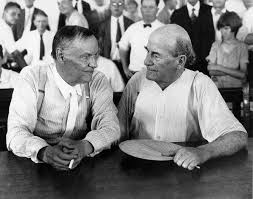
Most Americans aware of Darrow believe that Spencer Tracy’s depiction of him in Inherit the Wind is accurate. One commentator posits that “It’s safe to say that 99% of viewers of the play and movie assume that what they are seeing is veracious history. They are not.” Even die-hard Darrow loyalists admit that “The [Scopes] trial’s portrayal on Broadway and in the popular film Inherit the Wind, although grossly inaccurate, imprinted an indelible image of Darrow on the American consciousness.” A later, more objective, biographer concurs that “the power of the imagery [of Inherit the Wind] has lingered and cemented Darrow’s status.” [8] Darrow’s reputation, in other words, is based largely on an appealing actor’s dramatic performance in a fictional movie—not real life. [9]
In his Pulitzer Prize-winning account of the Scopes case, Summer for the Gods, Edward Larson concluded that “The modern Scopes legend emerged during a thirty-year period bracketed by the appearance of two enormously popular creative works,” Frederick Lewis Allen’s 1931 best-seller Only Yesterday [10] and the 1960 release of the move Inherit the Wind, based on the long-running Broadway play. [11] Larson states that “Far more than anything that actually happened in Dayton, these two works shaped how later generations would come to think of the Scopes trial.” [12]
In reality, the Scopes trial was hardly a triumph for Darrow. Darrow arrived in Dayton hoping to debunk organized religion. In the perspective of one observer:
Much of Darrow’s efforts at the trial amounted to a caustic diatribe against the Bible and Christianity. His anti-Christian hostility was so intense that there was fear on the part of liberal theologians and organizations that supported his evolutionary views that he might turn popular opinion against them. Darrow even turned his anger and hostility against Judge John T. Raulston by repeatedly interrupting and insulting him for which he was cited for contempt of court….
On the eighth day of the trial, Darrow asked the judge to instruct the jury to find his own client guilty as charged. This unprecedented concession of a client’s guilt by a defense lawyer kept Darrow from taking the witness stand as promised. One can only imagine what sort of questions Bryan might have asked Darrow about his beliefs in agnosticism and evolutionism after what Darrow had put him through.
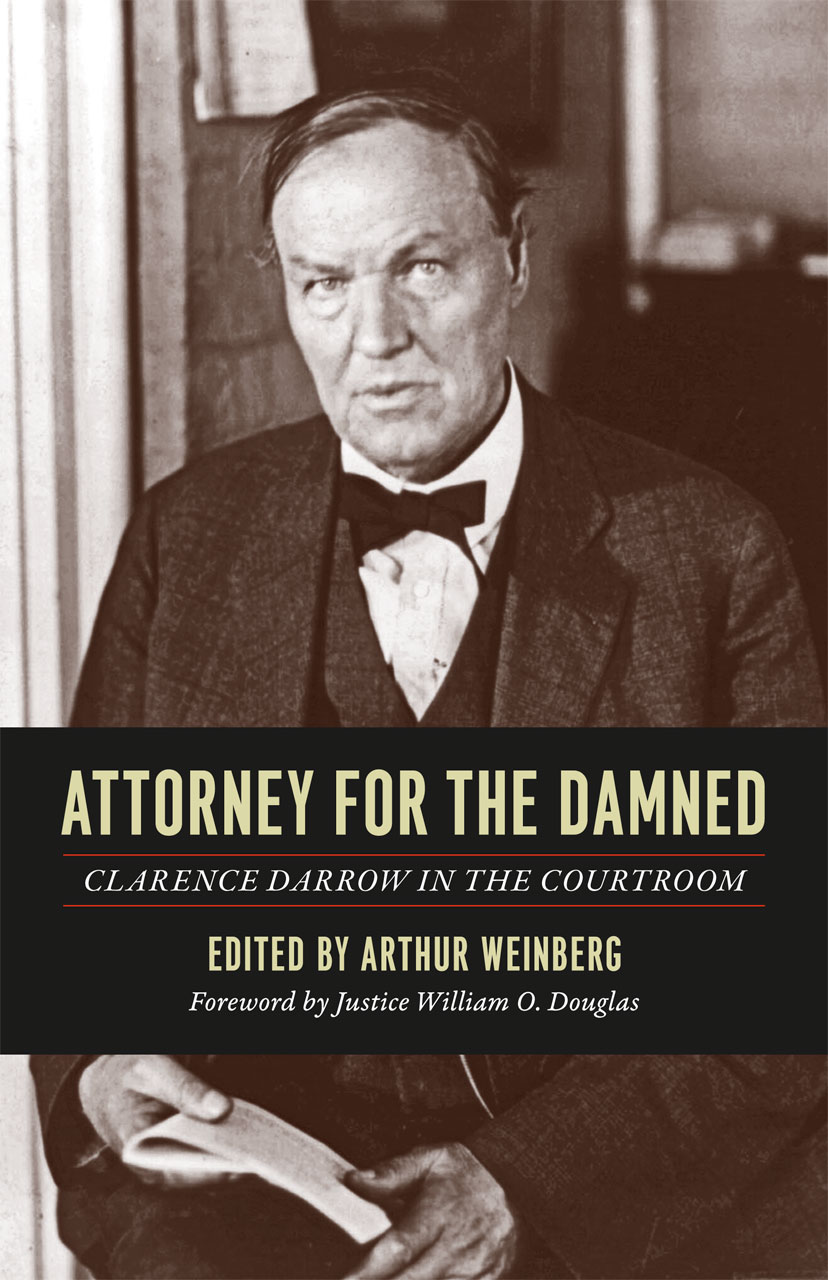
To liberals, Darrow is a hero, by dint of his advocacy for labor leaders, criminal defendants facing capital punishment, and—based on the mythology of Inherit the Wind–standing up against the intolerant forces of religious fundamentalism. A compilation of Darrow’s celebrated courtroom oratory, edited by Arthur Weinberg, was released in 1957 as Attorney for the Damned, with a foreword by Justice William O. Douglas, arguably the most liberal justice to serve on the Supreme Court in the pre-woke era. (Douglas’s legacy has become tattered since his death in 1980.)
Darrow’s Disreputable Acolytes
It is no wonder, therefore, that the disgraced founder of the discredited Southern Poverty Law Center, Morris Dees, cites Darrow’s memoir, which he claims that he stumbled upon in 1968 while killing time in a Cincinnati airport due to a flight delay, as changing his life forever. (I say “claimed” because both Dees and the demagogic organization he founded and ran, SPLC, were notorious fabulists.) “I was reading my own thoughts and feelings,” Dees gushed in his 1991 book, A Season for Justice. [13] Darrow’s words prompted Dees to sell his business that published direct-mail cookbooks and devote himself to civil rights law—becoming an early innovator of weaponized lawsuits now known as lawfare.
As if to prove that Darrow was his inspiration, thus wrapping himself in the mantle of a recognized courtroom champion, Dees used a treacly Darrow quote as an epigraph for A Season for Justice: “I have lived my life and I have fought my battles, not against the weak and poor—but against power, injustice, against oppression.” Characteristically, in 2001 the far-left American Bar Association republished A Season for Justice as A Lawyer’s Journey: The Morris Dees Story as part of its ABA Biography Series, with the theme “Lawyers Pursuing Justice.” Other lawyers featured in the series include Michael Tigar and Lawrence Walsh, both heroes to the Left.
The organized bar cultivates the image of lawyers as crusading advocates for the public good—so long as they advance the Left’s agenda. In 2012, the ABA honored Dees with its highest award, the ABA Medal. Seven years later, Dees was fired by SPLC for misconduct, amidst a staff revolt over his long-running sexual and racial harassment. Now SPLC is under indictment for fraud and money laundering. Like his idol, Dees was an unprincipled phony. It is telling that Dees, a conniving charlatan who milked a gullible public’s appetite for crusading lawyers, chose Darrow as his role model. Both ended their tawdry careers in ignominy.
Another organization that lionizes Darrow is the Freedom from Religion Foundation, which promotes atheism by, among other things, sponsoring billboards displaying the message “I’m an Atheist and I Vote.” Each year, FFRF also recognizes “civil libertarians, those who promote science and evolution, and/or freethought,” by selecting a recipient for the Clarence Darrow Award. Past honorees include Rep. Jamie Raskin, Ed Asner, and Elie Mystal.
Jury Tampering and Bribery
Darrow’s mythology began to crack in the early 1990s, with the publication of Geoffrey Cowan’s book The People v. Clarence Darrow in 1993. The book is a comprehensive account of the 1911 trial of the perpetrators of the deadly bombing of the L.A. Times building, killing twenty-one. The American Federation of Labor hired Darrow to represent James and John McNamara, both affiliated with the Bridge and Structural Iron Workers’ Union. (The McNamara brothers ultimately pleaded guilty to avoid the death penalty.)
Cowan’s book also explored the subsequent—and often-overlooked—trials of Darrow in 1912 and 1913 for attempting to bribe jurors in the McNamara case. Famed Miami attorney Roy Black notes that Cowan, a Yale-educated law professor, “spent five years researching the McNamara case and Darrow’s first bribery trial. Cowan researched personal memoirs, private papers and government documents. Cowan came to the conclusion that Darrow was guilty of bribery and that he plead the McNamaras guilty in an unsuccessful effort to escape the charges.”
As I summarized in a 2017 essay for Law & Liberty,
Cowan, who began the project an ardent admirer of Darrow’s, concluded that he did direct the jury tampering, even though he was acquitted of one of the charges. This was in the 1912 trial, which saw Darrow taking over from his erratic attorney, Earl Rogers, to mount his own defense. The second trial hung 8 to 4 in favor of conviction, but the prosecution decided not to pursue a retrial.
Based on his research, Cowan wrote, “it is fair to conclude that Darrow bribed both [jurors] Lockwood and Bain,” which was also the widely held opinion of even sympathetic reporters at the time. Even Darrow’s friends believed him guilty, as did his counsel Rogers. “All of the evidence gleaned from dozens of personal memoirs, private papers, and government files,” said Cowan, “adds further reason to believe Darrow guilty.”
Some in his “circle of friends” even “believed he had bribed juries before,” Cowan reported. For example, Darrow’s successful defense in 1907 of William “Big Bill” Haywood (leader of the Western Federation of Miners), charged with the bombing death of the former Governor of Idaho in another high-profile labor dispute
Cowan’s account was so persuasive that even Darrow fans and left-leaning legal academics such as “O.J. Dream Team” member Gerald Uelmen were forced to concede that
Professor Cowan presents convincing evidence that [Darrow] was, in fact, guilty as charged. In a [Washington Post] review of Professor Cowan’s book, Professor Alan M. Dershowitz concluded that “the convincing evidence that he bribed jurors in the McNamara case forever disqualifies Darrow from being a role model for lawyers.” Proclaiming that there is never any justification possible for corrupting the legal system, Dershowitz pronounced final judgment on Darrow: “He does not deserve the mantle of honor he has proudly borne over most of this century.” (Emphasis added.)
Amen. Bribing jurors is cheating. “Shoeless” Joe Jackson was banished from baseball, Pete Rose was banned from the Baseball Hall of Fame, Lance Armstrong forfeited his seven tainted Tour de France wins, and numerous Olympians (including Armstrong and Marion Jones) have been stripped of their medals—all for breaking the rules. Alan Dershowitz’s introduction to the 1996 paperback edition of The Story of My Life explains that “There is simply no justification for corrupting the legal system, even if it is done to level the playing field. Bribery and evidence tampering may be the tools of revolutionaries,…[b]ut a lawyer who practices law cannot employ such devices….If Darrow crossed that [ethical] line, as Cowan argues that he did, then he does not deserve the mantle of honor he has proudly borne over most of this century.” (Emphasis added.) [14]
Dershowitz did not stop there. In his 1995 introduction to The Story of My Life, Dershowitz revisits the Scopes trial, as falsely depicted in Inherit the Wind:
As with other legends, many liberties have been taken with Darrow’s cases. Consider, for example, the way in which Inherit the Wind portrayed the great confrontation between Darrow and his nemesis William Jennings Bryan, who assisted the prosecution in the Scopes “monkey trial.” In the most dramatic scene, the Darrow character calls the Bryan character as an expert witness on the Bible. The attack is scathing and merciless, as the man of science destroys the man of religion before our very eyes….As usual, the real story, as told in the trial transcript, was far more complex and far more interesting. The actual William Jennings Bryan was no simple-minded literalist. And he certainly was no bigot. He was a great populist, who cared deeply about equality and about the downtrodden….All in all, Bryan did quite well in defining his position, and Darrow came off as something of an anti-religious cynic. [15]
Dershowitz also points out that the biology text used by Scopes to teach evolution—and therefore relevant to the Scopes prosecution–contained racist stereotypes and proposed eugenic solutions to social problems such as crime and immorality thought to be genetically-related. The text Darrow defended called certain humans—those in prison, asylums, and the poorhouse—“parasitic” and a “low and degenerate race.” Short of extermination, the suggested remedy was “preventing intermarriage” and other measures such as involuntary sterilization. [16] Nazi Germany used such thinking as a justification for cleansing the Third Reich of inferior genetic stock. Progressives supported eugenics, a once-fashionable idea that failed to withstand the judgment of history.
The Massie Case
Bribing jurors is bad enough, but in the 1932 Massie case, Darrow would transgress further, suborning perjury in an unsuccessful effort to gain the acquittal (or at least a hung jury) for four vigilante killers, who murdered an innocent man in retaliation for a fabricated (and unproven) rape charge. The 74-year-old Darrow, in dire financial straits, had come out of retirement to defend a prominent socialite, Grace Fortescue, her son-in-law, Lt. Thomas Massie, and two Navy enlisted men for abducting and murdering a young Hawaiian, Joseph Kahahawai. The defendants, who acted in concert, believed Kahahawai had participated in the alleged gang rape of Thalia Massie, Fortescue’s daughter and Lt. Massie’s wife, in Honolulu late in the evening of September 12, 1931. The trial was held on the island of Oahu, amidst sensational publicity and a climate of anti-Hawaiian racism.


Darrow’s theory of defense, cloaked in psychiatric testimony, was “temporary insanity” on the part of Lt. Massie, whom he claimed had fired the gun, but the real strategy was to convince the jury to exonerate the conspirators on the basis of the “unwritten law” that an aggrieved husband was not responsible for a homicide if it was considered an “honor killing.” This was a form of jury nullification—convincing jurors to disregard the law and vote their conscience instead. To that end, Darrow had to convince the jury that Thalia Massie had been raped, and that Lt. Massie was the perpetrator of the shooting. Neither was true.
In an effort to exonerate his clients, Darrow knowingly presented false testimony regarding who fired the fatal shot in a murder case, as well as accusing Kahahawai of committing a rape that–as Darrow likely knew–had never occurred. The jury was not persuaded by Darrow’s defense case, and convicted all four of the conspirators of manslaughter. Darrow’s despicable conduct in the Massie case was not exposed until the publication of historian David Stannard’s carefully-researched account in the 2005 book Honor Killing: How the Infamous “Massie Affair” Transformed Hawai’i. Other authors have confirmed the accuracy of Stannard’s research, including Mike Farris in his 2016 book A Death in the Islands: The Unwritten Law and the Last Trial of Clarence Darrow.
I relied primarily on Stannard’s research for my 2026 article “Clarence Darrow’s Tawdry Finale” for Law & Liberty. My conclusion: “The Massie case is an indelible stain on Darrow’s career: a tropical precursor to Emmett Till, with Darrow defending the lynch mob.”
Loeb and Leopold
The Loeb and Leopold case is fascinating in its own right. In 1924, during the heyday of the Roaring Twenties, two genius-level teens from wealthy Jewish families in Chicago plotted the “perfect crime,” just to prove that they could do it. The pair, homosexual lovers at a time when this was shocking to decent society, ended up kidnapping and murdering Loeb’s 14-year-old cousin, Bobby Franks, in a bungled attempt to extort a ransom payment. They amateurishly left behind a trail of incriminating evidence and, when promptly arrested, confessed to the crime in great detail, each blaming the other for striking the fatal blow. The case generated sensational coverage nationwide. The public was outraged. With the benefit of an airtight case, the prosecution vowed to seek the death penalty.
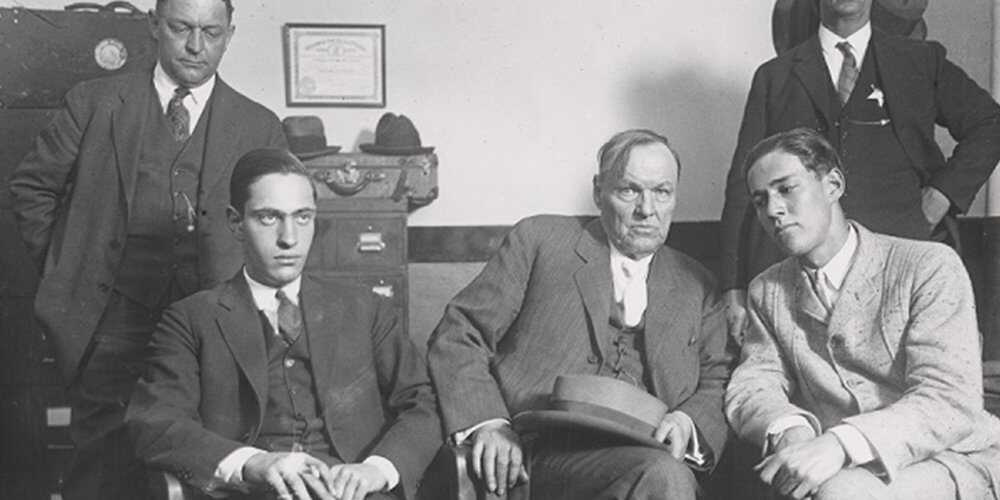
The wealthy families could afford the finest legal representation, so they hired Darrow. Darrow realized that a jury was unlikely to sympathize with privileged thrill killers, especially ones that were Jewish and homosexual. He also knew that presentation of an insanity defense would require a jury trial, which he wished to avoid. Accordingly, Darrow counseled Loeb and Leopold to waive a jury trial, plead guilty, and let him argue for leniency in sentencing from the trial judge, John Caverly, improperly using psychiatric testimony of mental illness in a bench trial as grounds for mitigation–in effect raising the insanity defense in a “back door” fashion to spare his unrepentant clients from the gallows. Such procedural trickery was typical for Darrow.
Darrow’s unconventional strategy worked, over the prosecution’s vigorous objections. After presenting confusing—and disputed–testimony from defense “alienists” (as psychiatrists were called at the time), Darrow delivered a marathon closing argument extemporaneously, for which he has received much praise. Accounts vary as to the length of Darrow’s oration. Some claim it went on for 12 hours over the course of three days; others insist that Darrow “only” spoke for about eight hours. In any event, Darrow is not revered for the length of his oratory, but for its rhetorical force.
Even here, accounts vary, although opinions regarding the persuasive effect of Darrow’s arguments are quite subjective. Some cite the closing argument in the Loeb and Leopold case as a masterpiece of persuasion—courtroom “magic”—that has been “long-heralded as a gold standard in legal circles.” Others fault it as disorganized, rambling, repetitive, disjointed, and occasionally offensive, such as when Darrow minimized the cruelty of Bobby Franks’ murder, solicited sympathy for the smirking killers, and even claimed that “as compared with the families of Leopold and Loeb, the Franks are to be envied, and everyone knows it.” [17]
Another author, Simon Baatz, in his book For the Thrill of It, reports that Darrow’s closing argument “droned on for three days, interminably rambling his way down rhetorical paths in a disorganized, chaotic mess of a speech. There was little structure to his remarks; he habitually veered off on a tangent at the slightest provocation.” Baatz continues: “Despite its length, his summation contained little of substance; Darrow scarcely even mentioned the scientific testimony introduced during the hearing. His audience fidgeted and yawned….” [18]
Even Darrow partisans concede that aspects of Darrow’s closing argument, laced with poetry, philosophy, and arguments in opposition to capital punishment, was “insulting,” unhelpful, and deserving of criticism. The only reaction that mattered, however, was that of the trial judge, who after listening to Darrow’s harangue spared the defendants from execution and sentenced them instead to life in prison for murder plus 99 years for kidnapping. In his 2004 book America on Trial, Alan Dershowitz raised the possibility that Judge Caverly’s decision not to impose the death penalty on Darrow’s clients may have the result of bribery. Chicago, Dershowitz charges, “had one of the most corrupt judiciaries in the nation.” [19] Dershowitz elaborates:
The defendants were rich. Their lawyer had almost certainly employed bribery in his career. There was no accounting for a portion of his large legal fee in this case. Despite Darrow’s brilliant and compelling advocacy, the distinct possibility remains that he enhanced its receptivity to this Chicago judge through bribery. This sort of suspicion becomes inevitable when a lawyer has employed improper tactics in the past. [20]
In any event, Darrow had “won.” Loeb and Leopold would not be hanged. An edited and sanitized copy of his closing argument was printed and widely sold in pamphlet form. Most people familiar with Darrow’s most celebrated oratory base their opinion on the cleaned-up version (or secondary accounts of it), not the unedited transcript of Darrow’s actual closing argument. As with the false depiction of the Scopes trial in Inherit the Wind, I concur with the sentiment that “Darrow’s closing has assumed a mythological status in legal history,” which is exaggerated and undeserved. [21] “Heartfelt pleas and soaring rhetoric” [22] may be noteworthy as theatre, or political advocacy, but they should not be praised as legal arguments made in a court of law.
The Truth Begins to Emerge
Darrow’s career received a major re-assessment in 2011, with the publication of John Farrell’s Clarence Darrow: Attorney for the Damned, which benefited from a careful review of available archival sources not available (or consulted) by prior biographers. One of the startling revelations in Farrell’s book is that Darrow’s long-suffering law partner, the noted poet Edgar Lee Masters (author of Spoon River Anthology), eventually became a bitter critic of the man. In 1934, Master wrote to President Franklin Roosevelt to persuade him not to appoint Darrow as chair of a National Recovery Review Board, to review criticisms of the controversial New Deal program, the National Recovery Administration (which was subsequently ruled unconstitutional in Schechter Poultry Corporation v. United States (1935)). Masters’ plea, which went unheeded, savaged his former law partner (1903-1911):
Money and publicity have been his life objects and to get them he has sacrificed parties and friends and principles all along. I do not refer to Darrow’s malodorous career, to his indictment for jury bribing in California, nor to his dubious reputation as a lawyer in Chicago, but rather to his insidious and subtle faculty of playing fast and loose with labor and capital, to his bewildering shifts and changes in which he has flirted with democracy, socialism, the single tax and anarchism; to his faithless attitude toward friends, leaders like [William Jennings] Bryan and others. [23]
In the course of his extensive archival research, Farrell uncovered additional evidence that Darrow had, in fact, bribed jurors in the McNamara case, and even in his own bribery trial. [24]
Despite his damningly-faint praise of Stone’s Clarence Darrow for the Defense as a “magnificent” use of Stone’s “skills as a novelist and biographer,” [25] Farrell rated the seminal book as “seriously flawed,” due to its acceptance of Darrow’s false mythology, perhaps owing to Stone’s reliance on the assistance of Darrow’s widow, Ruby, and son, Paul, in writing the book. [26] Farrell elaborates:
To cite one lasting error, he begins his story with a great set piece of American biography: the vivid and detailed description, complete with dialogue, of Darrow resigning [as corporate attorney] from the Chicago & North Western Railway over the government’s persecution of Eugene Debs and the American Railway Union. It places Darrow at the center of things in July 1894, confronting railroad president Marvin Hughitt, rushing back and forth between strife-torn Chicago and Governor Altgeld’s office in Springfield, and conferring with Debs in prison. Stone cites the “Darrow family” as his source, and his account has been accepted and repeated by authors ever since. It makes for great reading, but it is fiction. Darrow left the railroad after the death of his patron, William Goudy, in May 1893, worked at City Hall and then went into private practice, and in 1894 was preoccupied by the Eugene Prendergast case—which Stone calls “Pendergast” and erroneously places in 1895. Darrow was certainly restless at the railroad and ultimately did represent Debs, and his departure marked the start of a brave and principled career—but he did not quit in protest in 1894. Stone made other errors, and left out Darrow’s more unsavory clients and tactics. [27]
Thus, the most influential biography of Darrow, Stone’s Clarence Darrow for the Defense, opens with a lie.
Farrell’s research also confirmed that Darrow conceded to a friend that his best-selling autobiography, The Story of My Life, was as much “propaganda” as biography. [28] Regarding the Massie case, Farrell rated Stannard’s searing Honor Killing to be one of the “best accounts,” [29] and criticized Darrow’s inaccurate version of the facts. Darrow wrote about the Massie case in a 1932 article for Scribner’s Magazine, which was added as a chapter to later editions of The Story of My Life. Farrell notes that Darrow “continued to insist, knowing it was not true, that [Thomas] Massie fired the shot that killed Joe Kahahawai.” [30] In other words, the testimony by Thomas Massie that Darrow presented at the Massie trial was knowingly perjured (as was Thalia Massie’s testimony that she had been raped).
Unfortunately, despite the availability of newly-discovered archival materials, well-sourced in Farrell’s meticulously researched book, hagiographic tracts recycling discredited myths still abound, such as Andrew Kersten’s, American Iconoclast (2011), which Salon panned as “whitewash[ing] the less savory aspects of the masterful but flawed attorney’s career.” Salon concluded that it is difficult to portray Darrow as a crusading hero because “like most lawyers, he was at bottom a hired gun, motivated less by right and wrong than by what his client required. It is for this reason that few lawyers are remembered.”
Conclusion
Many things have changed in American society and law since Darrow passed in 1938, and his cremated remains were unceremoniously dumped in a lagoon in Chicago’s Jackson Park. [31] With the advent of television, the public no longer relies on actual trials to satisfy their insatiable appetite for courtroom drama. Fictional legal dramas abound—in books, movies, and multiple streaming platforms. True crime is a popular genre. In a post-New Deal world, struggles for “social justice” are no longer confined to the courthouse. The proliferation of plaintiff-friendly tort laws has provided a lucrative outlet for talented courtroom performers, in the vein of Melvin Belli and Joe Jamail, outside of the criminal law field. Radical lawyers such as William Kunstler, Ramsey Clark, Ron Kuby, Michael Tigar, Leonard Boudin, and Leonard Weinglass barely left a lasting impression on our culture, and some have already been forgotten.
The criminal defense bar now faces competition from prominent legal academics (e.g., Alan Dershowitz) and a host of Big Law hired guns. Progressive-oriented litigation is now a cottage industry for dark money-funded NGOs, left-wing organizations such as the ACLU, and—with unlimited resources—big firm pro bono programs. The fame of celebrity lawyers, even those with best-selling books, tends to be short-lived. Gerry Spence, Johnnie Cochran, Mark Geragos, and others enjoyed the spotlight for a time but are not remembered in the same fashion as Clarence Darrow. This is not because modern day courtroom gladiators are less talented, or less media savvy, or less accomplished; to the contrary, television coverage made them ubiquitous—almost commonplace.
Trial practice has become more sophisticated, procedural rules have tightened, and the era of marathon (sometimes days-long) oral arguments and free-wheeling jury appeals is over. In this new world, with abundant competition, and a more discerning public, Darrow would have difficulty standing out. Darrow’s advantage during his long career was that he was the original—“OG” as they say these days–and his mythology has gone unchallenged. More precisely, his mythology has been challenged, but believers maintain faith in the manufactured Inherit the Wind/Irving Stone/The Story of My Life version of Darrow. His fans want to believe the myth, just as children want to believe in Santa Claus.
The enduring—and seemingly irresistible–box office appeal of movies based on comic book super heroes demonstrates our culture’s puerile need to fantasize about champions for good coming to the rescue. Lawyers in particular desperately want to believe that they, too, are champions for good. [32]
The problem is that Clarence Darrow was not a real-life version of Atticus Finch, the hero of To Kill a Mockingbird. He was cynical and nihilistic, believing that the ends justified the means. Darrow once wrote, in an article for Esquire, that “in reality there is no such thing as justice, either in or out of court. In fact, the word cannot be defined…. The lawyer’s idea of justice is a verdict for his client, and really this is the sole end for which he aims.” (Emphasis added.)
Ever the egotist, Darrow was a deeply-flawed, and unethical, performer who used courtrooms as his stage. Salon begrudgingly conceded that despite his faults, few lawyers “could put on a show quite like Darrow.” He craved attention, and notoriety. His best-known biographer, Irving Stone, said that “telling the story of Darrow’s life was like writing about Paul Bunyan, John Henry, and other folk heroes.” [33] Roy Black, who considers himself a “Darrow scholar,” dismisses Stone’s influential book as “a little adolescent,” and concedes that “Stone wrote [it] to create the myth of Darrow.” Darrow’s mythology is ultimately a fantasy not supported by the factual record.
Fantasies must yield to reality, and the reality is that Darrow was a radical and an unscrupulous mercenary who represented gangsters, violent sociopaths, domestic terrorists, vigilantes, con men, corrupt businessmen, and crooked politicians. [34] A bohemian who supported the “free-love movement,” Darrow was an inveterate womanizer and philanderer. Despite claiming to be a supporter of women’s rights, Darrow failed to campaign for passage of the 19th Amendment, which enshrined women’s suffrage in the Constitution.
Ironically, the man heralded as America’s finest lawyer was no legal scholar. He wrote extensively, but focused on political, cultural, and philosophical matters. Even his avid admirers admit that “His great summations were more political and social policy than legal exposition.” Elaborating, a self-proclaimed “Darrow scholar” posits that
He blatantly played to the jury’s prejudices and made grand sweeping societal arguments that I find hard to believe would be allowed in today’s courtrooms. He was allowed an extravagant amount of time to make such a case. Many of his trials lasted months in the courtroom, and his final arguments were 8 to 12 hours long. No judge would allow that today. Some of his co-counsel complained about his social policy arguments. He almost lost the second bribery trial because he argued, against everyone’s advice, that the McNamaras were innocent. But he couldn’t help himself; he was more politician than lawyer. (Emphasis added.)
Darrow was imperfect in many ways, both as a man and as a lawyer. One critic of Darrow, attorney-author Mike Farris, has cataloged Darrow’s defects at great length in his 2024 book Blowhard: Windbaggery and the Wretched Ethics of Clarence Darrow. Farris’s book is a bracing rebuttal to the vast Darrow mythology. But the pertinent objection to Darrow is not that he was a radical, or a rake, or a bloviator. Those who take the law seriously—and this group ought to include all lawyers—should disdain Darrow because he was a cheater. Bribing jurors and presenting perjured testimony in court is a betrayal of our legal system. Just as athletes who cheat are shunned from the sport and stripped of their medals, lawyers who cheat should be scorned, not revered.
Bicyclists and baseball players should not be held to a higher ethical standard than lawyers—officers of the court.
Harvard Law School professor Alan Dershowitz, whom I regard as “one of the most impressive legal minds of his generation,” expressed an accurate and fair-minded judgment of Darrow when he said that “He does not deserve the mantle of honor he has proudly borne over most of this century.” Sadly, many lawyers, including some noted conservatives, continue to embrace Darrow’s unfounded mythology.
Footnotes
[1] Clarence Darrow, The Story of My Life (1996) at 27.
[2] Id. at 28-29.
[3] Id. at 28.
[4] Id. at 29-30.
[5] Introduction to 1995 edition of The Story of My Life, by Alan Dershowitz, at xi.
[6] In his 2016 book on the Massie case, A Death in the Islands, author Mike Farris describes Darrow’s self-serving account as “generously colored to justify his actions in the case.” Id. at 305. Irving Stone’s treatment of the Massie case in Clarence Darrow for the Defense is a one-sided version that uncritically presents a pro-Darrow point of view.
[7] John A. Farrell, Clarence Darrow: Attorney for the Damned (2011) at 532.
[8] Id. at 533.
[9] In his Pulitzer Prize-winning account of the Scopes case, Summer of the Gods, Edward Larson argued that another contributor to the Darrow myth was the “cartoonlike” coverage of the Scopes trial in Frederick Lewis Allen’s best-selling book Only Yesterday: An Informal History of the Nineteen-Twenties, published in 1931. Larson concludes that Allen, whose book was based on sometimes-inaccurate news reports of the trial, mischaracterized certain aspects of the case. “By portraying the Scopes case as a decisive defeat for old-time religion,” Larson stated, “Allen fit the episode neatly into his general conception of the twenties as a time when America repudiated its Victorian traditions.” Id. at 225-28. Although Allen was a journalist, not a historian, and his book was intended only as a popular summary of the decade’s headlines, Larson suggests that many subsequent historians repeated Allen’s flawed narrative.
[10] See footnote 9.
[11] Edward J. Larson, Summer for the Gods (1997) at 225.
[12] Id. Geoffrey Cowan confirms that “For me, and many of my contemporaries, Clarence Darrow was more legend than fact, more myth than man. He was a composite of actors, like Paul Muni, Spencer Tracy, Orson Welles, and Henry Fonda, all of whom brought him to the screen and stage.”
[13] Morris Dees, A Season for Justice (1991) at 95.
[14] Dershowitz, supra note 5, at vi.
[15] Id. at vii, x.
[16] Id. at viii-ix.
[17] Greg King & Penny Wilson, Nothing but the Night (2022) at 220-26.
[18] Simon Baatz, For the Thrill of It (2008) at 376.
[19] Alan Dershowitz, America on Trial: Inside the Legal Battles That Transformed Our Nation (2004) at 261.
[20] Id. (emphasis added).
[21] King & Wilson, supra note 17, at 228.
[22] Id.
[23] Farrell, supra note 7, at 461.
[24] Id. at 468.
[25] Id. at 532 (emphasis added).
[26] Id.
[27] Id. at 532-33 (emphasis added).
[28] Id. at 456.
[29] Id. at 536.
[30] Id. at 457 (emphasis added).
[31] Id. at 466.
[32] Some of Darrow’s lawyer-defenders are so committed to maintaining his status as a liberal icon that they try to rationalize his jury tampering! For example, in 2003 Santa Clara University law professor Gerald Uelmen, who has “always” regarded Darrow as a hero, wrote an entire law review article (entitled “Fighting Fire with Fire: A Reflection on the Ethics of Clarence Darrow”) in the Fordham Law Review suggesting that Darrow’s glaring ethical breaches and even illegal conduct might be justified because Darrow was merely trying to “level the playing field” when battling opponents with superior resources who were engaged in “hard ball” themselves. Framing the question as whether Darrow was just “fighting fire with fire,” Uelmen recounts at length the tactics of Darrow’s various opponents, attempting to establish moral equivalency. Ultimately, Uelmen concludes that:
This reflection on the ethics of Clarence Darrow has led me to an unanticipated conclusion. My personal hero, the man who inspired my own ambition to become a lawyer, turns out to have been not just unethical, but a lousy lawyer to boot. By fighting fire with fire, he ended up not only burning himself, but he seriously damaged the cause of labor as well. (Emphasis added.)
Instead of condemning Darrow, however, Uelmen pirouettes and absolves Darrow of his unethical tactics by claiming that Darrow turned over a new leaf and thereafter redeemed himself! Uelmen contends that:
If Clarence Darrow’s career had ended in 1911, he would surely be consigned to the hell of ignominy portrayed by the poetry of Edgar Lee Masters. But Darrow lived for another 26 years, and during that period he pursued a very different direction in his legal career. He never represented the cause of labor again, but the causes he took up were just as important. He truly redeemed himself and gained his place as an inspirational role model for future generations of lawyers. (Emphasis added.)
This ignores, of course, Darrow’s presentation of perjured testimony in the Massie case. It is shabby and disheartening to see a law professor countenancing egregious misconduct such as jury tampering. Alan Dershowitz has the more admirable position, quoted above: “There is simply no justification for corrupting the legal system, even if it is done to level the playing field.” Dershowitz, supra note 5, at vi.
[33] Farrell, supra note 7, at 532.
[34] Id. at 457.