Justice Clarence Thomas’s brand of originalism is “going further,” and to the Left’s dismay he is now on track to set the Supreme Court’s longevity record.
This essay originally appeared on Law & Liberty, on September 28, 2026 (here). Thanks to Instapundit (here), Power Line, How Appealing (here), Real Clear Books (here), and The Originalism Blog (here)!
Supreme Court Associate Justice Clarence Thomas is remarkable in many ways. His unusual journey from impecunious, father-less circumstances in Jim Crow-era Pin Point, Georgia to Yale Law School and the Marble Temple of the Supreme Court is dramatic enough, as I recounted here in 2020. Thomas has also survived vicious personal attacks at his 1991 confirmation hearing, a gauntlet of vile abuse—much of it overtly racist–unprecedented for a sitting Supreme Court justice, baseless assaults on his integrity and ethics, and snide insinuations that he was a ventriloquist’s dummy for his conservative colleague, the late Antonin Scalia. Being called an “Uncle Tom,” a “lawn jockey for the far right,” or “the cruelest justice” were among the milder insults hurled at Thomas. None of these aspersions were well-founded, yet Thomas has retained his good humor and is “universally adored”—even according to left-wing journalist Jeffrey Toobin!–by the Court’s staff for his friendly, unassuming demeanor.
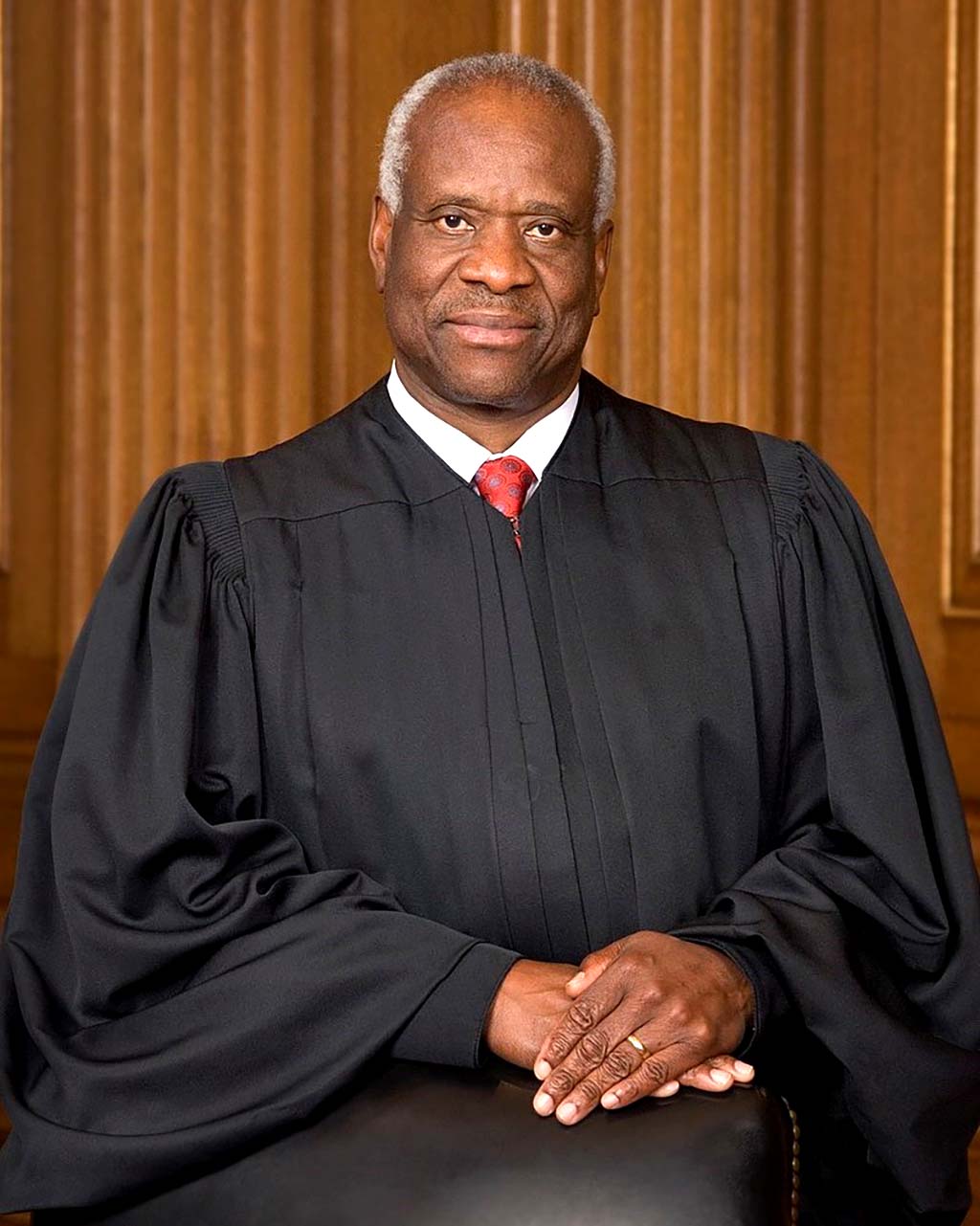
Despite the Left’s best efforts to derail Thomas’s confirmation and to discredit his tenure on the Court, Thomas—just 43 years old when he was appointed by President George H.W. Bush—is closing in on Justice William O. Douglas’s longevity record of 36 years, 206 days. With 34 years of service, the 78-year-old Thomas, now in second place, will surpass Douglas’s record on May 19, 2028. Thomas has disclaimed any intentions of retirement, and with continued good health should be able to set a new record for longevity on the Court. Thomas is not just a bench-warmer. His rigorous application of originalism and disregard for stare decisis have made him a jurisprudential pioneer. Thomas’s uncompromising approach has earned him an avid fan base and rock star status with the Federalist Society set.
Thomas’s confirmation travails generated a shelf of books, including his mentor Sen. John “Jack” Danforth’s Resurrection (1994). Thomas himself recounted his life story in his compelling (and best-selling) 2007 memoir, My Grandfather’s Son. A 2020 documentary on Thomas, Created Equal: Clarence Thomas in His Own Words, was based in large part on My Grandfather’s Son. Now, Sen. Ted Cruz has written a book about Thomas, Going Further: The Incomparable Clarence Thomas, that draws on nine and a half hours of interviews with the justice, whom he regards as a friend. Cruz weaves together Thomas’s compelling biography and his body of consequential Supreme Court decisions.
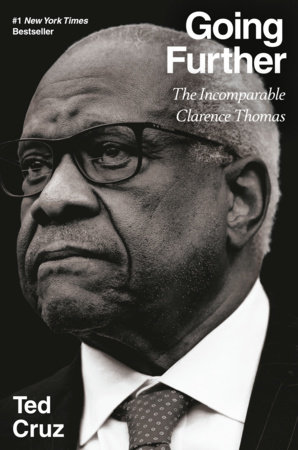
Cruz aims “to tell the story of Clarence Thomas’s life and explain why I believe he has been so incredibly impactful. Following the example of my subject, I will strive to speak clearly and directly, avoiding pretension or legalese and explaining his legacy in a way that anyone, lawyer or non-lawyer, can understand and hopefully appreciate.” At the end of Going Further, Cruz acknowledges that many of his readers will be young people, “reading this [book] because your mom or a friend or an uncle with excellent taste gave it to you for your high school or college or law school graduation….I hope you come away from this story inspired to stick to your principles…the way Clarence Thomas has always stuck to his.” Summarizing and quoting from his lengthy interviews with Thomas sometimes gives the book an “as told to” quality, but Cruz spices it up with his own anecdotes as a Supreme Court clerk, advocate, and member of the Senate Judiciary Committee. Cruz is not an invisible or silent narrator. Thomas’s unique biography is powerful enough to sustain the narrative.
Cruz dedicates the book to his “former boss and mentor, Chief Justice William Rehnquist,” along with the “great” Scalia, the “unwavering” Justice Samuel Alito, and the “incomparable” Justice Clarence Thomas, whom Cruz collectively rates as “the greatest jurists to serve on the Supreme Court in my lifetime.” Thomas stands out as the atypical black conservative who, in his youth, flirted with the Black Power movement. The Left despises Thomas, even more than Rehnquist, Scalia, and Alito, because according to liberal stereotypes Thomas is “supposed” to be a progressive proponent of the “living Constitution,” like his predecessor, Thurgood Marshall.
Cruz plumbs Thomas’s biography to discern how, in the face of cultural and tribal pressures that define many blacks’ political attitudes, and in the face of vicious criticism, Thomas ended up channeling Thomas Sowell rather than Malcolm X. Cruz does not exaggerate when he says that “The vitriol directed at Justice Thomas is different in kind than that directed at any other member of the Court or even any other person in public life.” Black conservatives face headwinds because of preconceptions about how blacks are expected to think. Thomas did not yield to those pressures.
Cruz suggests that if Thomas were liberal, “dozens of law schools would have given him honorary degrees. Scholarships would be endowed in his name. Elementary schools would be named after him…. An entire section of the Smithsonian’s African American museum would be devoted to him.” Instead, due to the Left’s double-standard on race, “When the Smithsonian opened its National Museum of African American History and Culture in 2016, it contained a single reference to Justice Clarence Thomas. That reference was buried in an exhibit about Anita Hill, who made shocking allegations against him during his confirmation hearing.” Cruz wrote Going Further as an antidote to the undeserved silence that has met Thomas’s accomplishments and legacy.
The title of the book derives from Thomas’s willingness to look beyond the Court’s precedents to determine what the words of the Constitution meant to the people who wrote and ratified it. Thomas became known for digging deeper than conventional assumptions and accepted orthodoxy when interpreting the Constitution. In his dissenting opinion in U.S. Term Limits v. Thornton (1995), Thomas reviewed the Court’s prior decisions and concluded “I would go further, for I see nothing in the Constitution that precludes the people of each State (if they so desire) from authorizing their elected state legislators to prescribe qualifications on their behalf.” To Thomas, the Constitution, properly construed, will always trump a contrary Supreme Court decision. Thomas’s willingness to reconsider the Court’s “living Constitution” precedents infuriates the Left.
For example, Thomas has questioned the correctness of New York Times v. Sullivan (1964), which created a First Amendment defense to libel claims by public officials. Fifth Circuit Judge James Ho, a former Thomas clerk, notes that “in Printz v. United States (1997), Thomas was the only justice to urge the Court to reaffirm that the Second Amendment right to keep and bear arms is “a personal right” — predating the Court’s Heller decision by over a decade.” Thomas was also an early critic of the 1984 Chevron decision, which was ultimately overruled in Loper Bright Enterprises v. Raimondo (2024). Thomas has long hewed to a narrow reading of the Commerce Clause, warning, Cruz explains, that “modern doctrine had effectively granted Congress a national police power the framers never intended.”
Thomas is perhaps best known for arguing—long before SFFA v. Harvard (2023)—that the Constitution is color blind and that racial preferences by government actors are unconstitutional. Thomas also insists that the Supreme Court has long misinterpreted the 14th Amendment’s Due Process Clause, including the use of substantive due process to recognize “unenumerated” rights and “incorporating” the Bill of Rights against the states. Cruz provides a non-wonky explanation of this theory. Thomas would rely instead on the Privileges or Immunities Clause of the 14th Amendment, which was rendered meaningless by the Supreme Court’s decision in the Slaughter-House Cases (1873).
One of Thomas’s first opinions upon joining the Court was a dissent in Hudson v. McMillian (1992), in which he (joined only by Scalia) pushed back against the notion that the Eighth Amendment’s prohibition of “cruel and unusual punishment” must be interpreted to reflect “the evolving standards of decency that mark the progress of a maturing society.” To the consternation of his colleagues, Thomas argued in his Hudson dissent that “The Eighth Amendment is not, and should not be turned into, a National Code of Prison Regulation.” Thomas’s dissent in Hudson earned him the sobriquet “the cruelest justice” by the New York Times. These examples barely reveal the extent of Thomas’s maverick instincts. His dissents, even though not immediately convincing the majority of his colleagues, pose provocative questions influencing the future direction of the Court’s opinions.
This contrarian streak, Cruz posits, explains both Thomas’s stubborn refusal to “think like blacks are supposed to” and his unsparing commitment to originalism, even in the face of prior decisions that Thomas feels were incorrectly decided. It takes a strong character to withstand the pressure to conform, and Thomas’s life experience provided exactly the forge necessary to harden his devotion to authenticity. “I’ve thought about jurisprudence and biography,” Thomas said in a 2016 interview. He continued: “Virtually none of this comes from Yale [where he attended law school]. Virtually none of it comes from scholars. It comes from the way you’re raised.” Cruz clarifies that “By ‘it,’ Justice Thomas means his idiosyncratic approach to the law, honed over three decades on the Supreme Court.”
The most formative influence in Thomas’s life was his hard-working, barely-literate, iron-willed, and utterly practical grandfather, Myers Anderson, who raised Thomas and his brother. Myers Anderson drilled Thomas constantly with his personal philosophy. Going Further ends with one of Myers’ many memorable maxims: “Boy, if it don’t make no damn sense, it don’t make no damn sense.” This statement is a bracing antidote to much fashionable gibberish masquerading as constitutional law.
Thomas’s tenure on the Court has been a testament to his courage and commitment to principle. Nowhere was Thomas’s courage more evident than on October 11, 1991, when he responded to the ambush staged by the Senate Judiciary Committee (chaired at the time by Delaware Sen. Joe Biden). The ambush consisted of unsubstantiated allegations of sexual harassment made by Anita Hill, who had worked under Thomas years before at the Department of Education and the Equal Employment Opportunity Commission, “leaked” at the last-minute after the Judiciary Committee had conducted five days of hearings and voted 7-to-7 on his nomination—sufficient to advance Thomas’s nomination to the full Senate for a vote. (The Democrats pulled the same stunt in the confirmation hearing for Brett Kavanaugh in 2018, based on even more time-worn allegations dating to Kavanaugh’s high school years!)
Cruz devotes an entire chapter to Thomas’s “confirmation by fire.” I vividly recall watching Thomas’s fiery rebuttal to Hill on television as he denounced her sleazy charges and the grotesque travesty that his confirmation hearing had become:
This is a circus. It is a national disgrace. And from my standpoint, as a Black American,…it is a high-tech lynching for uppity Blacks who in any way deign to think for themselves, to do for themselves, to have different ideas, and it is a message that, unless you kowtow to an old order, this is what will happen to you. You will be lynched, destroyed, caricatured by a committee of the U.S. Senate rather than hung from a tree.
It took enormous courage for Thomas to stand his ground, turning public opinion in his favor and leading to his confirmation by the full Senate. Nor did the Left’s attacks on Thomas end with his confirmation. Cruz presents a strong defense of Thomas’s longstanding friendship with real estate mogul Harlan Crow, whose hospitality and gifts became the fodder for scurrilous charges by dark-money-funded ProPublica that Thomas had improperly failed to disclose them. Under the judicial ethics and disclosure rules in effect at the time of the relevant events, food, lodging, and entertainment provided by friends were not subject to disclosure. Many of Thomas’s colleagues received similar (or more extensive) gratuities, without disclosure, but ProPublica and other media outlets focused only on Thomas.
Elsewhere, Cruz sometimes overstates certain points for rhetorical purposes. For example, Cruz states that, other than holding a law degree, Earl Warren (then the sitting governor of California) “had little in the way of experience to recommend him for the job” to which President Eisenhower had nominated him: Chief Justice. Warren was a disastrous appointment to the Court, but not for lack of legal experience; prior to being elected as Governor, he had served as California’s Attorney General (1939-1943) and District Attorney for Alameda County (1925–1939).
In the Epilogue, Cruz quotes Thomas expressing dismay at the direction the Court has turned in recent years:
“It’s not like when you were here,” he said, referring, presumably, to the mid-1990s, when I was a clerk and also to the 2000s, when I was regularly before the Supreme Court arguing cases. “It’s a whole different world up here. You change the Court, the composition, it really changes the Court…. And the newest addition, it was quite a change.”
Thomas was apparently referring to President Biden’s appointment of far-left Ketanji Brown Jackson to the Court in 2022.

In Going Further, Cruz combines biography, interviews, and commentary on Thomas’s opinions to produce a readable overview of the “incomparable” justice on track to break the Court’s longevity record. All fine, and well suited to younger readers unfamiliar with the man and his record. Going Further would make a great gift or stocking stuffer for college-age family members. However, Clarence Thomas deserves a deeply-researched, definitive biography such as Mollie Hemingway’s book on Samuel Alito (Alito: The Justice Who Reshaped the Supreme Court and Restored the Constitution) and James Rosen’s superb trilogy on Antonin Scalia.
That book remains to be written.