Justice Samuel Alito combines the finest qualities of jurist, scholar, cultural observer, and devoted American patriot.
This essay originally appeared in Law & Liberty on November 16, 2026 (here). Thanks to Real Clear Policy (here) and How Appealing!
Mollie Hemingway’s best-selling portrait of Justice Samuel Alito, Alito: The Justice Who Reshaped the Supreme Court and Restored the Constitution (reviewed here), published earlier this year, illuminated an unheralded conservative champion on the Supreme Court, often over-shadowed by his better-known “celebrity” colleagues, Antonin Scalia and Clarence Thomas. The sources Hemingway interviewed for her book invariably described Alito as brilliant, thoughtful, serious, calm, and modest. Unlike some of his colleagues, Alito does not crave attention or seek out the spotlight. Hemingway described him as “an improbable justice,” having arrived on the Court “solely because of his intellect and hard work. He is not a politician or gladhander. His personality and way of life are shockingly normal.”
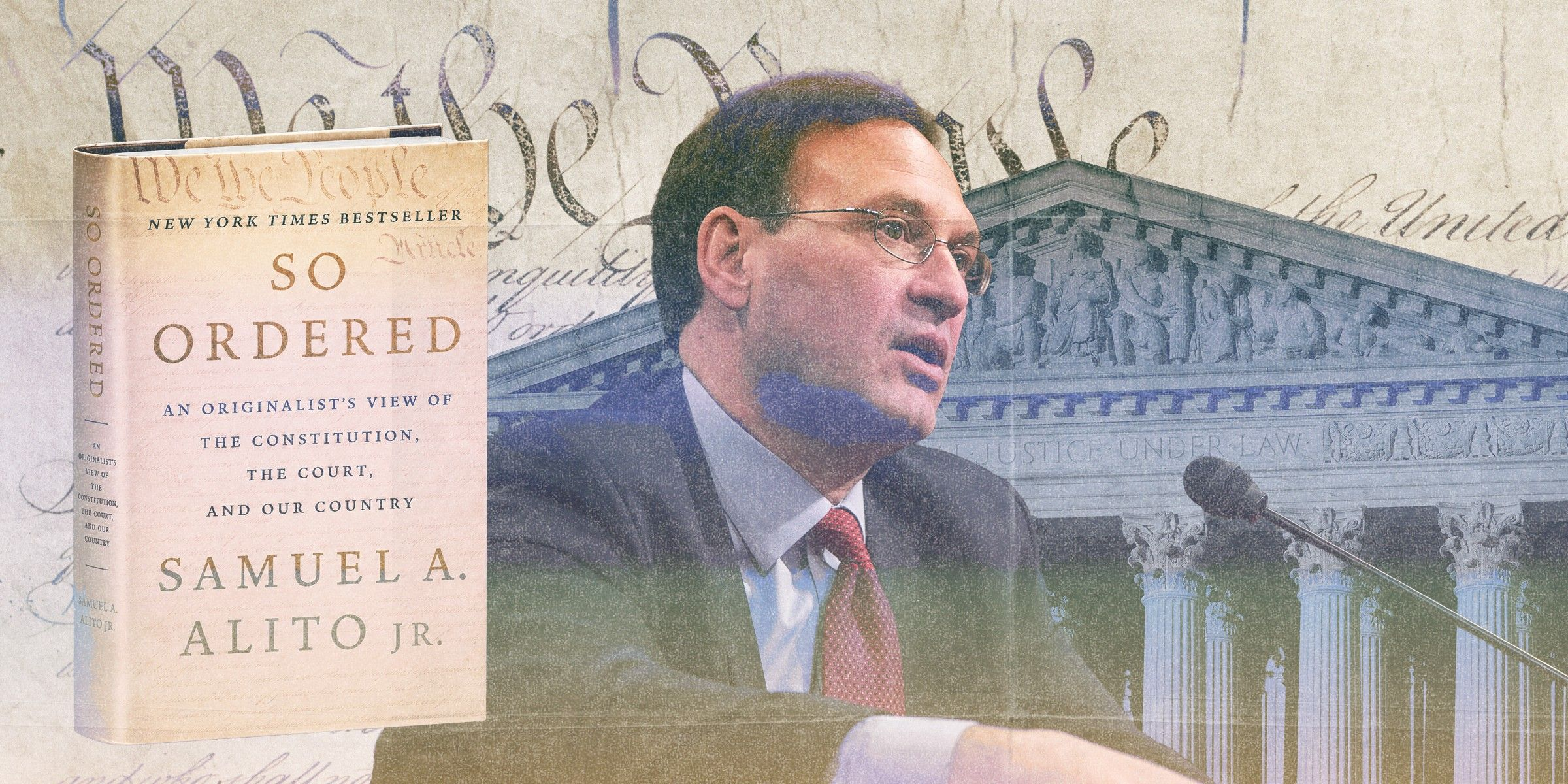
Alito’s enormous contributions to the Court’s jurisprudence—penning majority opinions in important cases such as Dobbs (2022), Janus (2018), Louisiana v. Callais (2026), Wolford v. Lopez (2026), McDonald v. Chicago (2010), Burwell v. Hobby Lobby (2014), Matal v. Tam (2017), and many others, including influential (and sometimes withering) dissents—are not fully appreciated because he is temperamentally the opposite of Scalia: low-key and self-effacing. Now in his 21st year on the Court, following nearly 16 years on the Third Circuit, Alito has finally written his own book, entitled So Ordered: An Originalist’s View of the Constitution, the Court, and Our Country. It is excellent, and an essential companion to Hemingway’s biography.
Courtesy of the Law & Liberty Symposium
It is, of course, not unusual for Supreme Court justices to write books while serving on the Court. William Rehnquist, both while an Associate Justice and as Chief Justice, wrote several–mostly concerning American history. Some of Alito’s colleagues, as newbies, wrote self-serving autobiographical tracts. Ketanji Brown Jackson received a nearly $3 million advance for her ghost-written best-seller Lovely One: A Memoir (2024). Sonia Sotomayor received more than $1.9 million in advances and promotional earnings for her 2014 memoir My Beloved World, which she wrote with the help of an Iranian-American poet, Zara Houshmand. In fact, Sotomayor dictated her memories into a tape recorder and Houshmand did the actual writing.
So Ordered is different. It is neither ghost written nor a self-serving autobiography. Instead, the book consists of adaptations of speeches Alito delivered to various groups on a myriad of topics over the course of 18 years (from 2007 to 2025). It is a deeply-personal peek into Alito’s intellectual worldview. Alito’s speeches, unlike those typically delivered by the inveterate raconteur Scalia (a posthumous compendium of which I reviewed here), are impressively substantive and characteristically cerebral. They are also highly diverse, touching on everything from judicial philosophy, to religious liberty, to popular culture, to baseball (his lifelong passion). As a native of Trenton, New Jersey, Alito is an avid—and unabashed—Phillies fan.
The 19 chapters are organized into five wide-ranging sections, Originalism and Textualism; The Role of Judges; Religious Liberty; Threats to the Constitution; and The American Experience. Many of the chapters discuss Supreme Court decisions, but Alito’s reflections cover (or touch on) many other subjects. Alito’s distinctive personality—and “voice”—are apparent throughout the book. The chapters read like essays, rather than speeches, complete with footnotes and an index. They are rigorous enough to satisfy a sophisticated audience but accessible to a layman.
If Alito has an ego, or a temper, it is not apparent in So Ordered. (Other adjectives commonly used to describe him are “mild mannered” and “polite.”) For example, in his discussion of textualism, Alito recounts an incident from his first full term on the Court. He had been assigned to write the majority opinion in Hein v. Freedom From Religion Foundation (2007), which had a “standing” issue. Alito distinguished but did not overrule Flast v. Cohen (1968), a Warren Court-era decision that Scalia deplored. Scalia refused to join Alito’s opinion, and filed a concurring opinion that called Alito’s reasoning “meaningless” and not “sane.” Alito took no offense, concluding—with remarkable equanimity—that “I knew the comments were not personal…. That was just Justice Scalia’s way.”
Conversely, in his discussion of the controversial decision in Bostock v. Clayton County (2020), which interpreted Title VII’s prohibition of sex discrimination to include sexual orientation and gender identity, Alito reprises his forceful dissent to the majority opinion written by Justice Neil Gorsuch. Using the disagreement to illustrate different approaches to textualism—the interpretation of statutes—Alito denounces the majority opinion as “remarkable,” “stunning,” and “indefensible,” while also pointing out that Gorsuch “is a fine justice and a friend, but on this occasion, I think he was wrong.” It is increasingly rare for justices on the Court to be able to disagree without being disagreeable–or to be able to advance an argument without being polemical or truculent.
This is yet another personality characteristic that Alito does not share with his Italian-American counterpart, Scalia. Alito comes across as a wise, well-informed, but unpretentious guy-next-door—an Everyman—with whom it would be easy to converse.
I do not wish to suggest that So Ordered is facile or jejune. To the contrary, Alito provides the most lucid and succinct explanation of originalism—its background, development, and vernacular—that I have ever seen. Alito points out that what is now called originalism began as a reaction to the “living Constitution” jurisprudence that was inspired by the New Deal Court’s embrace of legal realism, which eventually led to the hyper-activist excesses of the Warren and Burger Courts. It was initially thought that the antidote to judicial activism was the type of restraint and judicial deference espoused by Justice Felix Frankfurter and others in the 1950s. The problem, Alito contends, is that “The Frankfurter theory…leads to a form of judicial minimalism. Originalism, on the other hand, sometimes calls for bold action.” Alito firmly rejects the notion that originalism requires a passive role for the Court.
Alito dissects the various strands and theories of originalism, which he labels “turning points,” six of which he deems to be “wrong turns.” The seventh, “academic originalism,” comes closest to being correct, albeit with recognition of the real-world need to synthesize prior precedents and in most cases compromise with colleagues as necessary to achieve a majority. Alito, in my opinion the Court’s most capable doctrinal craftsman, has described himself as “practical originalist” and a “working judicial originalist.” He explains that this means that he is “a judge who strives to achieve originalist aims while working within the framework of our judicial system,” which requires some deference to precedent pursuant to the tradition of stare decisis (a doctrine Alito refers to as “doctrinal Burkeanism”).
For example, Alito points out that the Court rejected the argument made by some lawyers in McDonald v. Chicago (2010) that the Second Amendment rights recognized in D.C. v. Heller (2008) should be applied to the states under the Privileges or Immunities Clause of the 14th Amendment rather than by “incorporation” under the Due Process Clause. Despite the doctrinal shortcomings of the conventional path for incorporation, Alito notes that—in light of the 1873 decision in the Slaughter-House Cases–reliance on the long-moribund Privileges or Immunities Clause would be contrary to a century of case law and (as I and others have warned) open a “can of worms.” Specifically, Alito recognizes that “if the narrow interpretation adopted in the Slaughter-House Cases were discarded, a lot would potentially be up for grabs.”
Alito, who never inhabited the Ivory Tower of legal academia, concludes that “Judging is practical work with real-world consequences, and it is done under conditions that may militate against scholarly purity.” Ironically, the professoriate that theorizes about constitutional law and generates a cacophony of academic commentary about originalism, often misses that point. A practical originalist must not ignore common sense. In a refreshing rebuttal to what Alito calls “insecure originalism,” he posits that
When originalist analysis seems at first to lead to a result that makes no sense, sound originalist judges should go back and check their work….[W]e do not have an asinine or idiotic Constitution. So an originalist judge should not cavalierly or happily embrace results that defy common sense….[B]ecause we have a good Constitution, originalism generally produces good results….[O]riginalists should not be afraid to discuss good or bad results or originalism’s ultimate aim
Throughout, Alito makes it clear with whom and what he agrees—and disagrees. He is not a fan of Professor Adrian Vermeule’s “common good constitutionalism,” for example. Likewise Harvard’s Marxist law professor, Mark Tushnet. Despite being Catholic, Alito is skeptical of using natural law as a methodology for constitutional decision-making. Alito’s views on textualism largely conform with those of Scalia, whom he rates as “one of the most important justices ever to sit on the Supreme Court.” On the other hand, as a champion of religious liberty Alito takes strong exception to Scalia’s opinion in Employment Division v. Smith (1990), which interpreted the Free Exercise Clause of the First Amendment to allow the government to categorically burden specific conduct even though some groups engage in that conduct for important religious reasons. In Smith the conduct was ingesting peyote, but Alito cautions that a similarly-neutral ban on the consumption of alcohol (without Prohibition’s exception for sacramental wine) would prevent the celebration of Catholic Mass.
Alito devotes a chapter to Learned Hand, often regarded as the most esteemed American judge to never sit on the Supreme Court. Hand served as a district judge in the Southern District of New York, and then on the Second Circuit, for over fifty years. Although Hand’s views on textualism and constitutional interpretation do not comport with Alito’s, Hand was a judicial craftsman and a patriot, and Alito properly celebrates an impromptu speech Hand gave at age 72 to a large crowd in Central Park in 1944, at the height of WWII. The title was “The Spirit of Liberty.” The occasion was the annual “I Am an American Day” event, where newly naturalized citizens swore the Pledge of Allegiance.
Hand’s remarkable speech, reprinted widely to great acclaim, resonated because of its “affirmation of faith in ordinary Americans.” The speech, worth reading in full, contains these inspiring words, directed to newly-naturalized citizens who came to America seeking liberty:
What do we mean when we say that first of all we seek liberty? I often wonder whether we do not rest our hopes too much upon constitutions, upon laws and upon courts. These are false hopes; believe me, these are false hopes. Liberty lies in the hearts of men and women; when it dies there, no constitution, no law, no court can even do much to help it. While it lies there it needs no constitution, no law, no court to save it. (Emphasis added.)
This is why our culture—and assimilation—are so important.
Other notable chapters include an explanation of the Court’s emergency docket, which critics of the Court sometimes deride as a “shadow docket.” Alito roundly objects to this label:
[T]he idea behind the criticism…[is] that a dangerous cabal is deciding important issues in a novel, secretive, improper way; it acts in the middle of the night, hidden from public view,…without proper briefing or oral argument, and without issuing full opinions. This characterization of the “shadow docket” sounds sinister and threatening, but it paints a false picture.
Alito explains that the current Court has fixed many features of the process for seeking emergency orders, badly abused in the past (without complaint from leftist law professors). The worst abuse was arguably at the hands of the notorious Justice William O. Douglas, who once tried to unilaterally enjoin the bombing of Cambodia during the Vietnam War, while the Court was not in session, from his vacation home in rural Washington, and after Justice Thurgood Marshall had refused to grant the ACLU’s requested injunction. In truth, technology now permits litigation to proceed at a rapid pace, and errant decisions by rogue lower court judges—who until recently routinely granted nationwide injunctions–sometimes make emergency orders necessary. Alito’s defense of the Court’s procedures is thorough and well-taken.
The chapter entitled “Cracks in the Constitution” reflects on the fragility of our constitutional system, especially when we depart from the tri-partite structure carefully specified by the Framers. The “administrative state,” Congress’s delegation of lawmaking authority to a flotilla of unelected and unaccountable executive branch bureaucrats, is a particular concern. The rise of factions—dividing the polity into feuding ethnic, racial, religious, and economic blocs—is another major concern. Alito has been an unwavering opponent of racial preferences in college admissions and otherwise. Alito concludes that “If our country is to flourish, it is essential that every person, regardless of race or ancestry, be treated as a unique individual, not simply as a member of a racial or ethnic group that jostles for advantage with other groups.” Amen!
There is something in So Ordered for everyone: lawyers, constitutionalists, Burkean conservatives, traditionalists, gun owners, Catholics, Italians, baseball fans, patriots concerned about the future of the republic, students of history, devotees of Abraham Lincoln (with a stirring reflection on the Gettysburg Address), and ordinary readers who relish sensible ideas expressed in easily-digested prose.
The saga of Alito’s immigrant father’s rise from a background of poverty and illiteracy to middle class status as a college-educated Army veteran of WWII, family man, and vital civil servant is a testament to America as a land of opportunity, and the importance of a culture that encourages hard work, persistence, and self-improvement. Alito was not a nepo baby. He rose from humble origins. Alito worked hard, exercised self-discipline, served in the military, attended Princeton and Harvard Law School with distinction, and became a life-long public servant—ending up on the nation’s highest court. He clearly loves America and the Constitution, which he calls “the best the world has ever seen.”
So Ordered is neither gloomy nor pollyannish. Alito acknowledges that maintaining our constitutional republic requires civic commitment and eternal vigilance. He cautions that it is up to us—as citizens—to keep the lamp of liberty burning. He summarizes his message thusly:
Our constitutional system has endured for more than two centuries, but its preservation is not guaranteed. Today, as at other critical times in our nation’s history, it is an open question whether a constitutional system and culture that are “so ordered” can continue to flourish.
Alito would have made an excellent teacher, and Americans would be well-served to heed the lessons in this important book. In the words of Alexander Hamilton, writing in Federalist #78, Alito is indeed a “faithful guardian of the Constitution.”