Alito: A Justice In Full
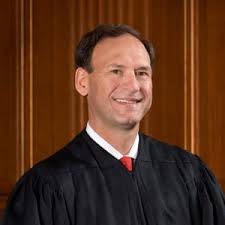
In the public mind, the taciturn Justice Samuel Alito is the least heralded conservative on the Supreme Court; Mollie Hemingway aims to correct that by revealing the formidable man beneath the robe.
This essay originally appeared in Law & Liberty on April 21, 2026 (here). Thanks to Power Line, Real Clear Policy (here), Real Clear Books, Real Clear Politics (here), and The Originalism Blog (here)!
Justice Samuel A. Alito, Jr. has served on the U.S. Supreme Court for 20 years, but has never gotten the attention—or credit–he deserves. Alito was nominated to the Court by President George W. Bush in 2005 to fill the vacancy created by the retirement of the moderate Sandra Day O’Connor, after Bush initially selected Harriet Miers, his little-known White House counsel, for the slot. (Miers was quickly forced to withdraw due to broad-based opposition over her lack of qualifications.) By then selecting Alito, a 15-year veteran on the Third Circuit Court of Appeals, Bush 43 did the nation a huge favor. Not only was Alito a vast improvement over Miers, his nomination also atoned for Bush 41’s disastrous appointment of David Souter, who proved over the course of his 19 years on the Court to be a closet liberal. Not Alito, who has been a conservative stalwart on the Court for two decades.

Alito long labored in the shadow of extrovert Antonin Scalia and jurisprudential maverick Clarence Thomas, who has been credited with re-discovering the “lost Constitution.” Unlike some of his attention-seeking colleagues, such as the late Ruth Bader Ginsburg (who was celebrated by her acolytes as the “Notorious RBG”) and Grammys-attending Ketanji Brown Jackson, Alito judiciously maintains a low profile. He may be the least publicly-recognizable justice—the opposite of a celebrity. Alito does not crave the spotlight; in fact, he has not attended a State of the Union address since 2010, when he was criticized for seeming to mouth the words “not true” when President Obama falsely—and inappropriately—accused the Court of having overruled “a century of law” in Citizens United v. Federal Election Commission (2010), which had been decided a few days earlier.
Ironically, Alito’s reserved demeanor, while methodically rolling back the doctrinal excesses of prior activist eras on the Court, may have led him to become the target of baseless attacks by liberal critics who mistake his plainspoken persona as weakness. Or perhaps the reason why Scalia was spared the abuse directed at Alito is that during Scalia’s tenure on the Court he was a fiery dissenter, whereas Alito—now part of a long-awaited 6-to-3 conservative majority—is penning majority decisions overturning precedents sacred to the Left, such as Roe v. Wade.

In any event, Alito’s lack of public recognition is about to change. Mollie Hemingway, well-known center-right journalist and best-selling co-author of an excellent account of the tortuous confirmation process inflicted on Brett Kavanaugh in 2018, Justice on Trial, has written the first biography of Alito, entitled Alito: The Justice Who Reshaped the Supreme Court and Restored the Constitution. In this decidedly friendly book, Hemingway makes the case that Alito is one of the most consequential jurists in the 21st century—the most consistent, and influential, conservative voice on the Court.
Hemingway’s research for Alito was characteristically thorough. As in Rigged, her best-selling account of the 2020 election, she conducted extensive interviews—nearly 100 people, some for multiple sessions—most of them conducted “on background.” The interviewees included “Supreme Court justices, federal judges, United States Senators, high-ranking former White House and cabinet officials, state legal executives, Supreme Court advocates, law professors, former clerks, permanent staff of the Supreme Court, legal activists, and childhood friends and family of Justice Alito.” In addition tothe extensive interviews, Hemingway consulted with legal scholars, pored over the Court’s decisions, and reviewed the essays presented at a symposium on Justice Alito’s jurisprudence held in March 2022, which were published in the Harvard Journal of Law and Public Policy.
In other words, Hemingway did a “deep dive” into Alito’s childhood, education, personal life, career, and ongoing record as a judge (including his service on the Third Circuit from 1990-2006), now spanning four decades. What emerges is the portrait of an earnest, even-tempered, hard-working, highly-intelligent, resolute, modest, self-effacing champion of the Constitution. Acquaintances use the same adjectives to describe Alito: quiet, calm, brilliant, polite, unassuming, courageous. Hemingway puts Alito’s 20 years of service as a justice in the context of the Court’s evolution from a hotbed of judicial activism under Chief Justice Earl Warren to its current alignment—a historic 6-to-3 conservative majority–and explains how Alito has played a key role in that shift.
Hemingway also digresses surefootedly into profiles of and anecdotes about the leading figures in political and legal circles during the Reagan-to-Trump epoch. As I said about Hemingway’s co-authored book on the Kavanaugh confirmation process, Justice on Trial, due to her extensive interviews “The reader feels like a fly on the wall, behind the scenes, as the events dramatically unfold.” Alito delivers the same insider scoop.
In terms of Alito’s “backstory,” there are eerie parallels with the better-known Scalia, 14 years his senior. Like Scalia, Alito is an Italian-American and a Catholic, born to immigrant parents, who were hard-working, middle-class, well-educated, and demanding. Both Alito and Scalia were born in Trenton, New Jersey, although Scalia was raised in Queens. Both were high-achieving students (high school valedictorians) who excelled in many extra-curricular activities, including debate. Both studied Latin. Alito attended Princeton, which had rejected Scalia to his considerable dismay and disappointment. Both attended Ivy League law schools (Alito, Yale; Scalia, Harvard), where they were editors of the law review. Neither clerked on the Supreme Court. There, the parallels end.
In temperament, Alito and Scalia could not have been more different. Scalia was a thespian, a raconteur, and a natural performer who reveled in his celebrity. Alito, in contrast, is shy, humble, introverted, and cerebral, but with a wickedly dry sense of humor that can be unleashed in a dead-pan manner (on display in his 2012 keynote address at the Federalist Society’s 30th Anniversary Gala Dinner). Alito’s passion is baseball. He played Little League through the eighth grade and even as an adult was an accomplished softball player who could hit, throw, and field. Alito is a diehard Philadelphia Phillies fan whose ambition as a young man was to be the commissioner of Major League Baseball. In college, Alito developed an interest in the Constitution, under the tutelage of two influential faculty members, Walter Murphy and Charles Miller. As a debater at Princeton, Alito admired Justice John Marshall Harlan II, who was one of the rare dissenters to the Warren Court’s activism, and had the opportunity to meet with him when the debate team traveled to Washington, D.C.
Despite his nascent interest in constitutional law, Alito’s decision to attend law school was made “without much enthusiasm.” He would have preferred to study literature, political theory, and philosophy in graduate school. His required active military service post-graduation forced a practical decision, and Alito chose to attend Yale Law School in order to study under famed professor Alexander Bickel, who unfortunately was stricken with cancer, preventing Alito from taking any courses from Bickel before he passed at age 49 in 1974.
Even Alito aficionados will learn interesting nuggets from Hemingway’s thorough research. For instance, Alito is only justice now on the court to have served in the military, participating in ROTC at Princeton and ultimately reaching the rank of Captain. His ROTCcommander atPrinceton was Andrew Napolitano! And readers learn that Alito’s nickname among clerks is “Big Sam,” owing to his being the tallest member of the Court.
Unlike Scalia, Alito was never a full-time academic (although he occasionally taught part-time as an adjunct), nor did he spend time in private law practice. Rather, after graduating from Yale he devoted himself to a career in public service, with stints as a law clerk to Third Circuit Judge Leonard Garth (turning down a Second Circuit clerkship to be closer to his family in New Jersey); Assistant U.S. Attorney in New Jersey (where he met his future wife, Martha-Ann); assistant to the Solicitor General under Rex Lee and Charles Fried in the Reagan administration, arguing 12 cases before the Supreme Court; serving as Deputy Assistant Attorney General under Charles J. “Chuck” Cooper in the Office of Legal Counsel during the tenure of Attorney General Edwin Meese; and, wishing to return to New Jersey with his family, U.S. Attorney in New Jersey.
In 1990, when he was not yet 40, Alito learned of an impending opening on the Third Circuit. To fulfill his “dream” of becoming a federal appeals court judge, Alito sought and obtained a nomination from Bush 41 and received Senate confirmation—unanimously, by voice vote—on April 27, 1990. Alito ended up serving on the Third Circuit for nearly 16 years before getting the nod from Bush 43 to replace the retiring Sandra Day O’Connor. His Senate confirmation to the Supreme Court was not smooth sailing, but he was approved by a vote of 58 to 42.
All of this is relevant background to Alito’s service on the Supreme Court, where Hemingway contends that Alito has “quietly and consistently delivered justice while also anchoring the team through its most controversial decision in half a century.” She refers, of course, to the landmark decision in Dobbs v. Jackson Women’s Health Organization (2022), which overruled Roe v. Wade (1973) and Planned Parenthood v. Casey (1992) (co-authored by the aforementioned David Souter) to remove abortion rights from constitutional protection. Hemingway devotes an entire chapter to Dobbs and all its internal drama and intrigue. Dobbs laid to rest one of the most controversial, highly-criticized, and doctrinally-dubious decisions in Supreme Court history. Alito wrote the opinion for a 6-to-3 majority in Dobbs, the culmination of what Hemingway describes in chapter 4 as “building the best Court in history.”
Sadly, for many Americans, the remarkably-disciplined Alito is best known for two things, neither of which should define him. First, a draft version of his opinion in Dobbs was the subject of an unprecedented leak by an unknown source at the Court, an egregious betrayal of trust and breach of norms at an institution that depends on discretion and relies on public confidence. Hemingway calls the leak “by far the worst in the Court’s history,” because it was “a full draft opinion on the most contentious issue in American politics.” The widely-publicized leak escalated already-high public tensions to such a degree that an armed would-be assassin stalked the home of Justice Kavanaugh one night with the intent to kill him before the final decision could be issued. (Due to threats, the Alitos had been moved to a secure location.)
Alito later said that the leak made the justices “who were thought to be in the majority in support of overruling Roe and Casey targets for assassination because it gave people a rational reason to think they could prevent that from happening by killing one of us.” This must have been especially terrifying for the author of the leaked opinion. Despite the numerous threats against the justices, and even noisy protests outside of the justices’ homes, night after night, Attorney General Merrick Garland shamefully refused the enforce federal laws against such activities when done “with the intent of influencing any judge,” which was obviously the purpose. Despite an internal investigation directed by Chief Justice John Roberts, the identity of the leaker has never been discovered.
Second, and possibly as payback for Alito’s authorship of Dobbs, the media concocted an absurd controversy over his wife’s flying an “Appeal to Heaven” flag (a Revolutionary War-era design commissioned by George Washington in 1775 that for 60 years flew over the San Francisco City Hall, among other places) at the couple’s New Jersey beach house, which is in her name. Hemingway devotes an entire chapter (entitled “False Flags”) to debunking the bogus attacks on Alito and other conservative justices (in particular Clarence Thomas), showing the media’s double standard and the blatant bias of the well-funded organization ProPublica, which targeted conservative justices with teams of reporters sent around the country to search for damaging information.
The reason Alito is in the cross-hairs of left-wing critics is that he is so effective in turning the tide on the Court away from liberal activism—the so-called “living Constitution.” Although she is not a lawyer, Hemingway provides a very capable analysis of the legal principles and constitutional issues at the heart of the Roberts Court’s shift in recent years, which some liberal law professors attribute to Alito. In addition to writing the majority opinion in Dobbs, Alito has authored major decisions in McDonald v. Chicago (2010) (extending Heller’s Second Amendment protection to the states), Burwell v. Hobby Lobby (2014) (recognizing the religious freedom of corporations), and Janus v. AFSCME (2018) (overruling Abood to protect the First Amendment rights of non-union government workers).
Alito represents a different breed of originalist than some of his colleagues. Eschewing the increasingly theoretical complexity of academic originalism, Alito brought to the bench a common sense approach to decision-making—what he calls “practical originalism.” He does not interpret the Constitution (or the text of statutes) in a vacuum, but considers its historical context. For example, in the 2020 decision in Bostock v. Clayton County, concerning whether “gender identity” and “transgender” status are encompassed within Title VII’s prohibition of discrimination on the basis of “sex,” Alito strenuously dissented from originalist Justice Gorsuch’s majority opinion.
Alito looked beyond the naked text of the statute and concluded, in light of the historical context, that Congress meant only to protect women from discrimination in the workplace, not sexual orientation or “gender identity.” As he explained in an interview in the Wall Street Journal:
“I reject the idea that a statute should be interpreted simply by looking up the words in the dictionary and applying that mechanically,” he says. Justice Gorsuch did something like that in Bostock v. Clayton County (2020), in which the court held that Title VII of the 1964 Civil Rights Act, which prohibits employment discrimination “because of . . . sex,” covers “sexual orientation and gender identity.”
Justice Gorsuch reasoned that because sex is essential to the definition of both categories, such discrimination is “because of” sex. But in 1964 homosexuality was subject to widespread disapprobation, and gender identity “hardly existed as a concept, even among professionals in the field,” as Justice Alito says. “When it’s very clear that the author of the text . . . cannot have meant something, then I don’t think we should adopt that interpretation, even if a purely semantic interpretation of the statute would lead you to a different result.”
In his Bostock dissent, Alito accused the majority of engaging in legislation and declared that “The Court’s opinion is like a pirate ship. It sails under a textualist flag, but what it actually represents is a theory of statutory interpretation that Justice Scalia excoriated––the theory that courts should ‘update’ old statutes so that they better reflect the current values of society.”
Similar considerations lead Alito to eschew First Amendment absolutism. In a series of solo dissents and concurrences, Alito has departed from his colleagues by declining to extend First Amendment protect to so-called “crush videos”—literally depicting animals being crushed to death on camera (U.S. v. Stevens); selling gruesomely violent video games to minors (Brown v. Entertainment Merchants Ass’n); and organized protests to insult the families of dead soldiers at military funerals (Snyder v. Phelps). On the other hand, in Murthy v. Missouri (2024), Alito (joined by Thomas and Gorsuch) dissented from the majority’s ruling that that the plaintiffs had not established the Biden administration’s coerced suppression by social media platforms of dissenting views regarding COVID-19. Shortly after the Court’s decision was handed down, Facebook co-founder Mark Zuckerberg publicly confirmed that the White House had in fact repeatedly coerced Facebook to censor posts, and expressed his regret at acceding to it.
In addition to his majority and dissenting opinions, Alito is also known for influencing the direction of the Court’s decisions through his skillful questioning of counsel during oral argument, often extracting concessions or revealing logical gaps that cause parties’ legal theories to collapse. His incremental approach to interpreting (and sometimes limiting) Supreme Court precedents has enabled him to build coalitions, unlike colleagues who give short shrift to stare decisis.
It is difficult to summarize a justice’s career while it is still underway, but in the final chapter of the book Hemingway tries to assess Alito’s legacy. Wholly free of vanity and pretense, Alito has been described as “all steak, no sizzle.” His clerks, who invariably have prior experience clerking for a lower court judge, marvel that Alito “is the only boss they have had who can sit down in front of a blank screen and draft a full opinion including footnotes and parentheticals.” This, at a time when many judges (and even justices) depend heavily on their clerks to write opinions.
Hemingway’s most profound insight is to compare Alito to the prophet Isaiah, ministering to a Nockian Remnant. Alito, she writes, “represents the best of mid-twentieth-century America, a country that is disappearing,” just like the declining fortunes of his hometown of Trenton. She concludes that “Samuel Alito is an improbable justice,” having arrived on the Court “solely because of his intellect and hard work. He is not a politician or gladhander. His personality and way of life are shockingly normal.” It requires humility for a judge “to stay focused on the specific facts of a case and remain appropriately skeptical of comfortable theories of textual interpretation.”
Summing up the man, Hemingway says that Alito’s “practical originalism,” which requires both common sense and an understanding of everyday Americans, demands a rare form of character:
The justice’s decision must be both a convincing legal argument and agreeable to the American public who must live with it. Otherwise, he risks becoming another celebrity justice, a peacock on the bench preening for an audience that already agrees with him. In other words, practical originalism requires a wise and even-tempered judge. (Emphasis added.)
Hemingway should be commended for bragging on a jurist too modest to do so for himself. Alito is a must-read for conservatives interested in the Supreme Court.