Despite credible revelations of unethical conduct, Clarence Darrow continues to enjoy undeserved esteem and respect.
I have previously written about the overrated (and under-scrutinized) career of Clarence Darrow, most recently an essay on my blog (Misrule of Law) entitled “Debunking Darrow and His Deluded Disciples: A Liberal Legal Icon Loses His (Undeserved) Luster.” I provided examples of Darrow’s sleazy ethics: his philandering, bribing jurors, bending procedural rules when it suited his clients’ interests, and—in the so-called Massie case—suborning perjury.
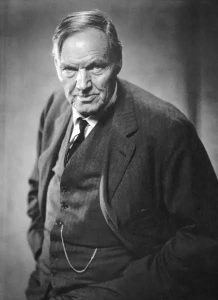
Darrow posing for posterity
I recently read yet-another book about Clarence Darrow, Dean Strang’s Worse Than the Devil: Anarchists, Clarence Darrow, and Justice in a Time of Terror, published in 2013. The book concerns a criminal trial held in Milwaukee in 1917 which resulted in the conviction of 11 Italian anarchists for criminal conspiracy based on a violent altercation—a riot, really–in the Bay View area of Milwaukee.
The riot was precipitated when armed protesters disrupted a rally staged by a local minister, the Rev. August Giuliani, who presided over the Italian Evangelical Mission Church, which was engaged in outreach and settlement work in the city’s volatile Third Ward. The anarchists were mainly atheists opposed to the Great War (WWI, then in progress) who objected to Rev. Giuliani’s patriotic, evangelical message. Some of the protesters may have been Catholics angry that Rev. Giuliani appeared to disparage their faith. In any event, shots were fired; two rioters were killed and two policemen were injured.
In the late 19th and early 20th centuries, Milwaukee was overwhelmingly populated by immigrants—over 80 percent. Many of the Italian immigrants were Sicilian. The city was wrought with ethnic, religious, economic, and political turmoil. Domestic unrest was not limited to Milwaukee; this was the era of anarchist Emma Goldman, the Haymarket Square bombing in Chicago, labor violence instigated by the Industrial Workers of the World (or “Wobblies”), Sacco and Vanzetti, labor strikes led by the radical Eugene Debs, etc. Recall that in 1901, President William McKinley was assassinated by an anarchist, Leon Czolgosz, in Buffalo, New York.
The trial of the 11 rioters, all non-citizen aliens, was held shortly after a bomb was detonated in Milwaukee’s central police station, killing nine police officers and a civilian. (Both of the police officers who were injured in the riot were killed in the subsequent bomb blast.) The bomb was originally planted at Rev. Giuliani’s church, and was later taken to the police department after it was discovered. The perpetrators were never identified. The community outrage over the bombing and the tragic loss of life surely inflamed the trial of the rioters, even though the defendants in that case were all in custody pending trial at the time of the bombing.
Darrow played no role in the contentious, three-week trial of the rioters. The prosecution was led by hard-charging District Attorney Winfred Zabel. The trial judge was August Backus. The defendants’ counsel at trial was William Rubin, who feuded with Zabel. After 17 minutes of deliberation, the jury found all 11 defendants guilty. Judge Backus later sentenced them all to 25 years in prison. Darrow was retained to represent the defendants in their appeal to the Wisconsin Supreme Court. In 1919, the Wisconsin Supreme Court reversed the convictions of nine of the defendants. Bianchi v. State, 169 Wis. 75, 171 N.W. 639 (1919). Eventually, Governor John J. Blaine commuted the sentences of the two defendants who remained in custody. All of the defendants were deported upon their release.
Dean Strang, a criminal defense lawyer, is sympathetic to Darrow, citing his self-serving autobiography, The Story of My Life, and Irving Stone’s hagiographic Clarence Darrow for the Defense for biographical details. Strang scarcely mentions John Farrell’s definitive—and more neutral—biography of Darrow, Clarence Darrow: Attorney for the Damned, even though it was published in 2011, two years before Worse Than the Devil. Worse Than the Devil covers the historical background, underlying events, bombing, and Milwaukee trial in some detail, as well as the appeal, but the most interesting revelation comes in Strang’s discovery of long-forgotten secret grand jury proceedings conducted years after the principal events were concluded. These records, never before reviewed or discussed, comprise the real bombshell in Strang’s book.
The grand jury was convened in 1922 to investigate allegations of corruption against Zabel. The special prosecutors appointed by Judge Backus (at Zabel’s request) conducted an inquiry that lasted nearly a year and produced more than 4,000 pages of transcribed testimony. The grand jury uncovered no bribes, graft, etc. regarding Zabel or his older brother, William, who served as Zabel’s deputy district attorney and became district attorney himself in 1932. However, testimony by Zabel’s assistant district attorney who participated in the trial of the 11 Italian anarchists revealed what Strang describes as “a previously unknown episode in which America’s greatest trial lawyer, Clarence Darrow, perhaps tried directly to corrupt the justice system.” [pp. xii-xiii]
In a nutshell, the testimony of Frederick Groelle, who helped Zabel try the riot case but played no role in the appeal (he resigned effective January 1, 1919), told a bizarre story. Strang concludes that “While the evidence is not conclusive, it is also not weak.” [p. xiii] To summarize Strang’s findings: the trial of the rioters in 1917 generated “a wastebasket of threatening letters” sent to the prosecutors; after the trial, a gunman confronted Groelle’s wife and daughters one evening as they were returning from the theater; after the trial, bombs were planted next to Zabel’s house; all of this made Groelle and Zabel terrified of retribution by the anarchists.
According to Groelle, who had been granted immunity for his testimony, Groelle suggested to Zabel that Zabel meet with Darrow to discuss “fixing” the record on appeal to assure reversal by the Wisconsin Supreme Court. In exchange, the anarchists would call off their threatened reprisals against the prosecutors. The facts show that Zabel and Groelle traveled to Chicago to meet with Darrow—an unusual development in a criminal case. According to Groelle, the trial judge, Backus, was consulted about the arrangement. In the pre-stenographic era, trial proceedings were not mechanically recorded. Verbatim transcripts didn’t exist; in their place were penciled summaries and shorthand.
Accordingly, a critical aspect of any appeal was an agreed-upon “bill of exceptions” showing that the alleged error occurred and that the relevant objections were preserved. In this appeal, Zabel, Darrow, and Backus agreed on the bill of exceptions. The Wisconsin Supreme Court’s unanimous decision in 1919 resulted in the reversal of convictions for nine of the 11 defendants. Darrow then applied to the governor for a pardon for the remaining two defendants, in the course of which Darrow mentioned that he was “advised and informed” that the trial judge (Backus) and the prosecutor (Zabel) would be weighing in.
It is odd that Darrow would make such a statement, unless some type of arrangement was in place. It was even more odd that the hard-charging prosecutor and the judge who sentenced all the defendants to 25 years in prison would be inclined to support pardons for two defendants whose convictions had been upheld on appeal. But that is exactly what happened. It turns out that the governor was unwilling to pardon the last two defendants if doing so would prevent their deportation. Ultimately, Gov. Blaine commuted their sentences to time served, and on February 9, 1922 they were released from state custody and deported.
Strang’s theory that Darrow agreed with Zabel and Backus to “fix” the trial transcript to ensure reversal, in exchange for the anarchists’ ceasing their campaign of terror against the prosecutors, is corroborated by Groelle’s sworn testimony and various items of circumstantial evidence. If true, Strang maintains that the arrangement “would be dishonest and a breach of public trust.” [p. 185] Another grand jury witness, Frank Carchidi, testified that he overheard statements from anarchists attesting to the quid pro quo. Strang concludes: “Carchidi’s testimony and Groelle’s partial endorsement of it further support the conclusion that Zabel, Groelle, and Darrow in fact discussed fixing the eleven Italians’ appeal.” [p. 187]
While we will never know for sure whether a corrupt bargain was made, Strang reminds us that—based on Darrow’s prior record of allegedly bribing jurors in the McNamara case in Los Angeles—“By our lights today, there is little or no doubt that Darrow crossed lines that conventionally honest lawyers do not cross.” (Emphasis added.) [p. 190] The footnote supporting the foregoing sentence is Strang’s only reference in his book to John Farrell’s Clarence Darrow: Attorney for the Damned, which Strang acknowledges “explored Darrow’s dark side more fully than earlier” biographers. [p. 253 fn. 86]
All in all, Worse Than the Devil is an interesting postscript to the debunking of the Darrow myth.
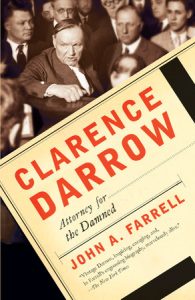
John Farrell exposed the myth